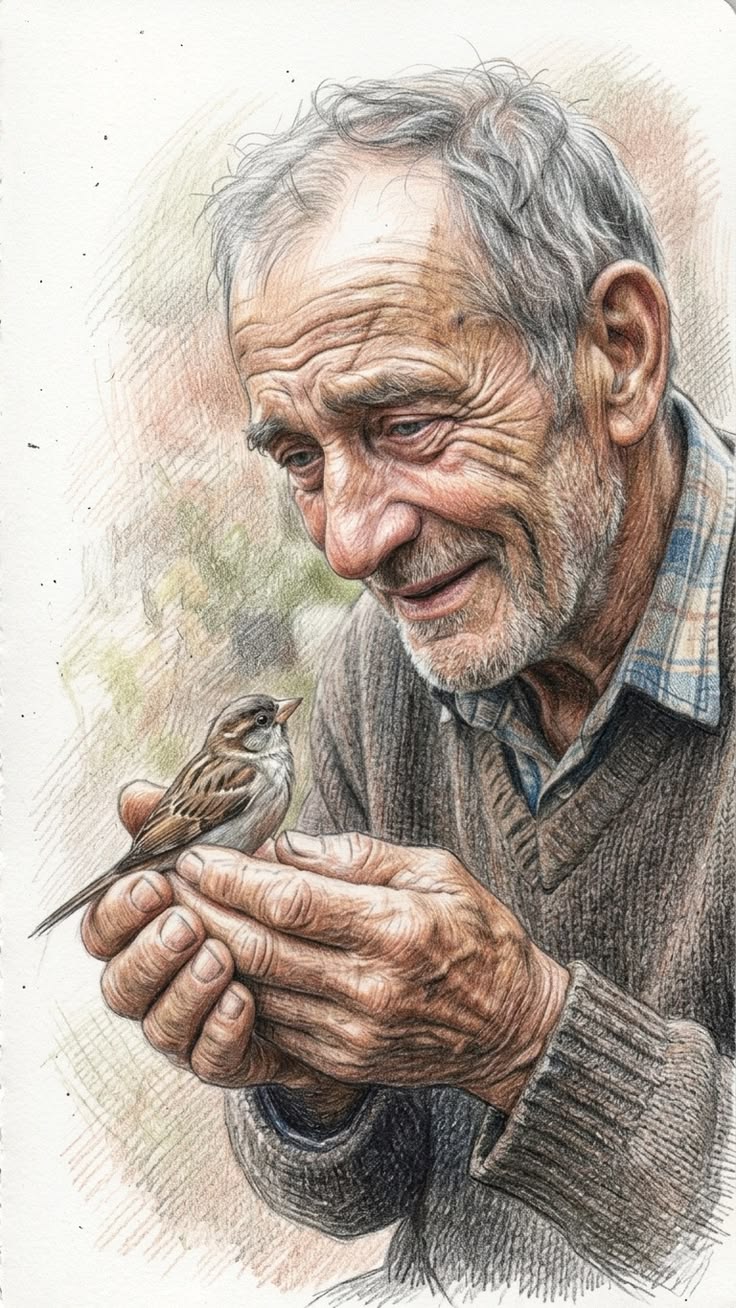
Earl Hadley hadn’t spoken to another human being in eleven days.
Not since his daughter, Renee, had dropped off a casserole on the front porch — didn’t even knock — and driven her silver SUV back down the gravel road without looking in the rearview mirror. He’d watched from the kitchen window, hands wrapped around a coffee mug gone cold, and said nothing. What was there to say? They’d had the argument a hundred times. She wanted him in a facility. He wanted to die in the house where he’d been born.
So Earl made do with silence.
He was seventy-nine years old, and his world had shrunk to four rooms and a back porch. His wife, Gloria, had been gone six years. His dog, a beagle named Chester, three. The vegetable garden had gone to weeds the summer after Chester died, because there was no one to share the tomatoes with, and a man alone can only eat so many tomatoes before they start to feel like a punishment.
On the twelfth morning, he found the sparrow.
It was huddled against the bottom step of the back porch, one wing held at a wrong angle, its small chest heaving with the effort of being alive. Earl stood over it for a long moment, his arthritic knees aching in the September chill, and considered his options. He could leave it. Nature was nature. He knew that better than most — sixty years of farming had taught him that mercy and cruelty were often the same hand reaching down.
But he bent, slowly, the way old men bend when they know the getting-up will cost them, and he cupped the bird in both hands.
It weighed almost nothing. That was the first thing that hit him. All that life — the heartbeat hammering against his palm like a tiny fist knocking on a door — and it weighed almost nothing at all.
He brought it inside.
He made a nest from a shoebox and an old flannel shirt that still smelled, faintly, of engine oil and the man he used to be. He set the box near the radiator. He crushed crackers into crumbs and set out a bottle cap filled with water. He did all of this slowly, deliberately, the way he used to do things when they mattered.
Then he sat at the kitchen table and watched the bird breathe.
“You’re a stubborn little thing,” he said. His voice came out strange — rusty, like a hinge unused too long. He cleared his throat. “Remind me of my wife.”
He smiled at that. First smile in a while.
He named the bird Pete, though he couldn’t have said why. Pete seemed like a name that required no explanation. Over the following days, Earl fell into a routine built around a four-ounce sparrow. He woke at six — earlier than he had in years — to check on the bird. He researched sparrow diets on the old laptop Renee had set up for him, navigating the internet with two-fingered patience. He learned that sparrows liked millet and sunflower seeds, so he drove his truck — first time in three weeks — to the farm supply store in town and bought a small bag of each.
Lena, the girl at the register, said, “You doing okay, Mr. Hadley? Haven’t seen you in a while.”
“Got a patient at home,” he said, and meant it entirely.
Each morning he talked to Pete. Not baby talk — real talk. He told the bird about the farm in its prime, the years when this land had fed twenty families and Earl had worked from before sunup until the stars came out, and Gloria would bring sweet tea to the field and sit with him while the day cooled down. He told Pete about Renee as a little girl, before the distance had grown up between them like a fence neither one had meant to build. He told Pete about Chester, and about the particular cruelty of outliving everyone you loved.
Pete, for his part, listened with one bright black eye and ate the millet without complaint.
By the end of the second week, the wing had improved. Earl could see it — the way the bird held itself differently, more upright, less like something bracing for the worst. He felt the change in himself, too. He was eating regular meals. He was sleeping a full night. He had called Renee — not about the facility, just to talk — and they had spoken for forty minutes about nothing important, and it had been the best conversation they’d had in years.
On a cool October morning, he carried Pete outside.
He stood at the back porch railing, the same railing he’d built with his own hands in 1987, and he opened his palms the way you open a book you’re not sure you’re ready to finish.
Pete stood on his thumbs for a moment. Looked at him. That one black eye, steady and unafraid.
“Go on,” Earl said. His voice didn’t shake, and he was proud of that.
The sparrow flew — not gracefully, not all at once, but in the stubborn, lurching way of something that has learned what it cost to be grounded and has decided never to forget it. It landed on the fence post at the edge of the yard. Sat there a moment. Then it was gone into the October sky, which was the specific blue that only comes after summer finally admits it’s over.
Earl stood there a long time, hands still open.
Then he went inside, washed the shoebox out in the sink, folded the flannel shirt, and called Renee again.
“I’ve been thinking,” he said, when she answered. “About coming to visit. Not to stay. Just to visit.”
She was quiet for a moment. Then: “I’ll make up the guest room, Dad.”
He hung up the phone and stood at the kitchen window, looking out at the fence post.
Sometimes the thing that saves you weighs almost nothing at all.
