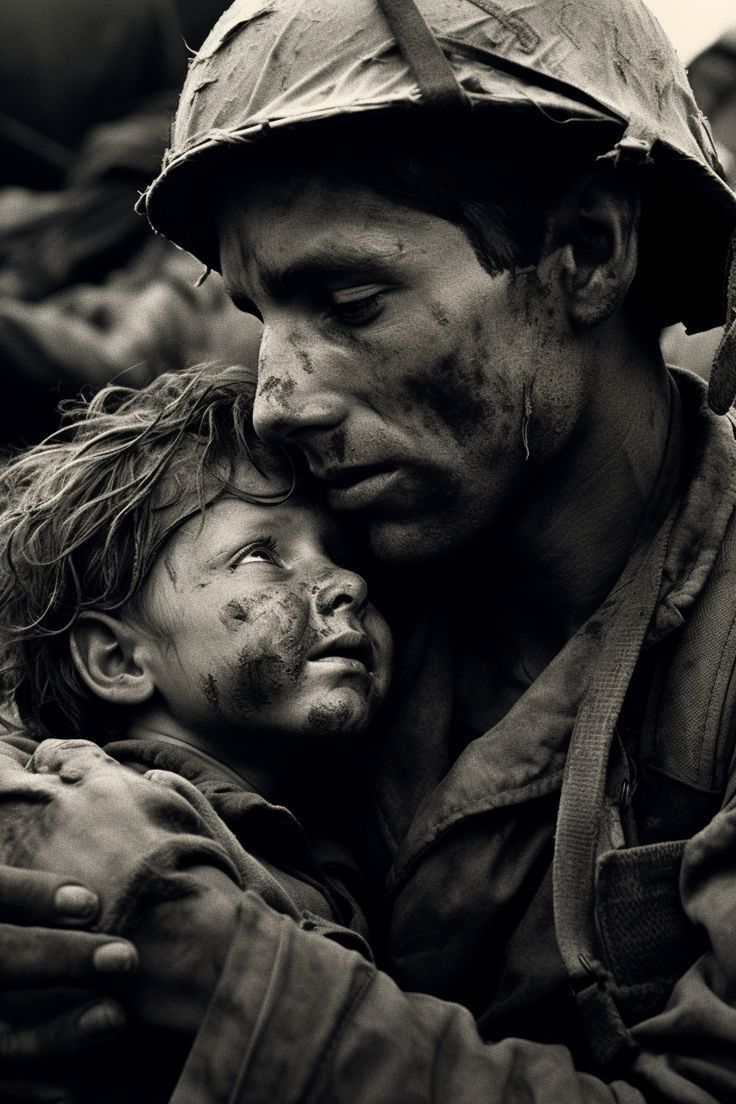
The child weighed almost nothing.
That was the first thing Corporal James Whitaker noticed when he pulled her from the collapsed doorway — how little she weighed, maybe thirty pounds, maybe less, light in his arms in a way that felt wrong, like holding something that had been hollowed out by everything that had happened to her. She was perhaps three years old. Perhaps four. It was hard to tell. Her hair was matted with dust and something darker that he didn’t look at closely. Her face was the face of a child who had already used up all her crying and come out the other side into a silence that was worse.
She looked up at him and did not scream.
That was the second thing he noticed. That she didn’t scream.
In his eight months in-country, James had learned that children screamed when soldiers picked them up. It was reasonable. It was correct. Men in helmets and body armor, smelling of sweat and gun oil, appearing out of smoke and noise — of course children screamed. It was the appropriate response to an inappropriate world. But this child looked up at his face with those enormous, exhausted eyes and simply — waited. As if she had already decided that whatever came next, she would endure it the way she had endured everything else.
He pulled her closer against his chest, more to hide his own face than to comfort her.
His sergeant, Delgado, moved past them without slowing. “Let’s go, Whitaker. We’ve got a perimeter to establish.”
“Yeah,” James said. He didn’t move.
The village — what remained of it — smoked quietly around them. It had been a crossfire situation, the kind that the briefings described in flat, geometric language: converging vectors, suppressing fire, collateral structural damage. In the briefings, villages were diagrams. On the ground, they were places where people had kept chickens and argued about money and put their children to bed at night with the particular hope that tomorrow would be unremarkable.
Tomorrow had not been unremarkable.
James sat down in the rubble with the child still in his arms because his legs had made that decision independently of his brain, which was still trying to process the geometry of the briefing and failing to make it fit what his eyes were seeing. The child settled against him with the unsettling trust of the very young and the very exhausted. Her hand found his collar. She held it.
He thought about his daughter, Emma, who was two and a half and currently — according to the math he did compulsively and automatically, the way soldiers do — asleep in a house in Clarksville, Tennessee, in a room with yellow walls and a nightlight shaped like a star. His wife, Dana, would be asleep too, probably curled on her side facing Emma’s monitor, the way she slept now, half-listening always.
He thought: Emma weighs more than this.
He thought: This child has no one.
Both thoughts sat in him simultaneously without resolving into anything useful.
An aid worker appeared from somewhere — a young woman with a red vest and a face that had the look of someone who had learned to absorb impossible things without breaking, or at least without breaking where anyone could see. She crouched down across from James, spoke to the child in the local language, soft and low. The child turned toward the voice but didn’t release James’s collar.
“She’s asking if you’re going to leave her,” the aid worker said, looking at James.
He didn’t know what to say. He was leaving. That was the nature of what he was. He was a man who had come from somewhere else and would return to somewhere else, and the village would remain, damaged and smoking, and he would eventually be in Clarksville, Tennessee, with his daughter who weighed more than this child and his wife who slept facing the monitor.
“Tell her—” he started.
He stopped.
The honest answers were not the right answers and the right answers were not honest, and he sat in the rubble of someone else’s ordinary life trying to locate a third option that was both.
“Tell her she’s safe right now,” he finally said. “Right now, she’s safe.”
The aid worker translated. The child looked up at James again with those ancient eyes. Then she tucked her face against his neck, and he felt her exhale — long and slow and shuddering — like a creature putting down a weight it had been carrying too long.
He held her for twenty more minutes while the perimeter was established without him. Delgado came back twice and said nothing either time, which was its own kind of grace.
When the aid worker finally took her — carefully, gently, the child transferring from James’s arms without waking — he stood up and adjusted his helmet and walked back to his unit and did not speak for the rest of the day. The men who knew him let him be. The men who didn’t know him mistook his silence for toughness.
He came home four months later to yellow walls and a star-shaped nightlight and a daughter who had learned three new words while he was gone. Dana made his favorite meal and they sat at the kitchen table and she asked how he was, really, and he said he was fine, really, and she looked at him the way she had always looked at him when she knew something was sitting in him that he hadn’t found words for yet.
She waited.
She was good at waiting.
He almost told her about the child that night. He got close. The words were there, in the right order, ready to be spoken. But Emma laughed at something from her room — a sudden, bright, uncomplicated laugh — and the moment passed, and he let it pass, and carried the child home inside him instead, the way soldiers carry things that weigh almost nothing and somehow everything.
