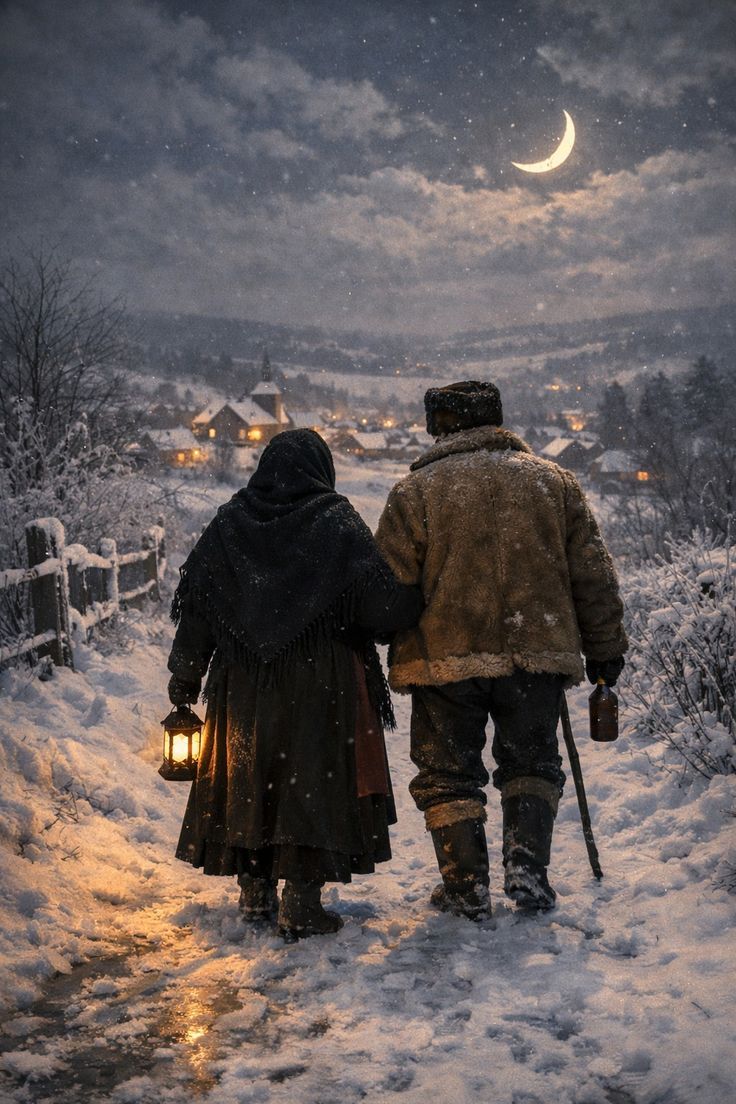
They had been walking this road together for fifty-one years.
Marta knew every stone beneath the snow without seeing it — the slight dip where the fence post had sunk three winters ago, the place where the path curved left just before the old miller’s field, the frozen puddle that hid beneath fresh powder and caught careless feet. She knew this road the way she knew Aleksei’s breathing in the dark — by feel, by memory, by the particular intimacy of a life lived in one place with one person for so long that the two of you become a single map of each other.
Tonight the snow was falling softly, the way it did when it meant to stay.
“Slower,” she said, not looking at him.
“I’m fine,” he said, the way he always said it.
She slowed anyway, adjusting her lantern so its light fell across the path at his feet. He wouldn’t thank her for it. He never did. That was alright. After fifty-one years, gratitude didn’t need to be spoken out loud. It lived in the small adjustments — the way she slowed without making a show of slowing, the way he let her, without pretending he didn’t notice.
The village below them glowed amber through the falling snow. From up here on the hill, it looked like something a child might have made — a cluster of warm lights tucked between white hills, smoke rising from chimneys, the old church steeple just visible through the bare trees. Marta had left this village once, when she was twenty-two, for the city. She had stayed eight months before something in her chest — something without a precise name, some quiet gravitational pull — had drawn her back.
She had never left again.
Americans, she thought, were always leaving. She didn’t mean this unkindly. She had a granddaughter in Chicago now — Sofiya, who sent photographs of tall buildings and smiled with the particular brightness of someone building a new world from scratch. Marta admired that. She also didn’t understand it, the same way she didn’t understand certain birds that flew thousands of miles when they could simply stay. But then, perhaps staying required its own kind of courage that wanderers didn’t always recognize.
Aleksei coughed — once, dry, brief — and she felt it in her own chest the way you feel a sound in a room you know perfectly well.
“The doctor said—”
“I know what the doctor said.”
She let it go. The snow fell. The lanterns swung gently with their steps, throwing light that moved the shadows back and forth like breathing. Above them, the crescent moon hung between two clouds, thin and bright as a new blade, indifferent to everything below it in the beautiful, total way that moons are indifferent.
They had met on a road not unlike this one. She’d been carrying firewood. He’d been going the wrong direction and too proud to admit it. She had not laughed at him — or rather, she had laughed, but kindly, in a way that somehow did not humiliate. He told her years later that was the moment he knew. Not her face, though her face was lovely. Not her voice, though her voice was warm. It was the laugh — precise and generous at once, the laugh of someone who found the world funny without finding people contemptible.
He had turned around and walked with her back toward the village.
He had been walking with her ever since.
Fifty-one years of winters. Of summers that smelled like cut hay and warm earth. Of autumns when the forest above the village turned colors that seemed implausible, almost theatrical, as if nature were showing off. Of springs that arrived later than you wanted and more beautiful than you remembered. Fifty-one years of bread made on Tuesday mornings, of arguments about small things and silences about large ones, of children born and grown and gone, of parents buried in the churchyard they were walking toward now, on the occasion of old Father Benedikt’s name day, for which Marta had made a walnut cake that sat wrapped in cloth in Aleksei’s coat pocket.
An ordinary evening.
She thought about Sofiya in Chicago, probably awake right now — it was afternoon there, she calculated, though time zones still struck her as mildly absurd, the idea that the same moment could be afternoon in one place and midnight in another. Sofiya would be at work, in an office building of glass, looking at numbers on a screen. She would be wearing the kind of clothes Marta didn’t entirely understand — sharp and efficient and somehow exhausted-looking. She would be checking her phone. She would be moving fast.
And here her grandmother was, moving slow, in the snow, with a man who walked with a stick now and said I’m fine when he wasn’t, carrying a lantern on a hill above a village that most of the world had never heard of and never would.
Marta did not pity herself. That was not what she felt.
What she felt — standing for a moment at the crest of the hill before the path descended toward the warm lights below — was something for which she also didn’t have a precise name. Something between gratitude and grief and a vast, quiet love for everything that was exactly as it was and would not always be. Aleksei stopped beside her without her asking. He looked at the village the way he always looked at it from this hill — with the expression of a man looking at something he chose, repeatedly, every day, and would choose again.
She took his arm.
He didn’t say anything.
Neither did she.
The snow fell on the lanterns, on the crescent moon, on the sleeping rooftops below, on fifty-one years of footprints in the same road, walked by two people who had long ago decided that this — exactly this — was enough.
They walked on, down the hill, toward the light.
