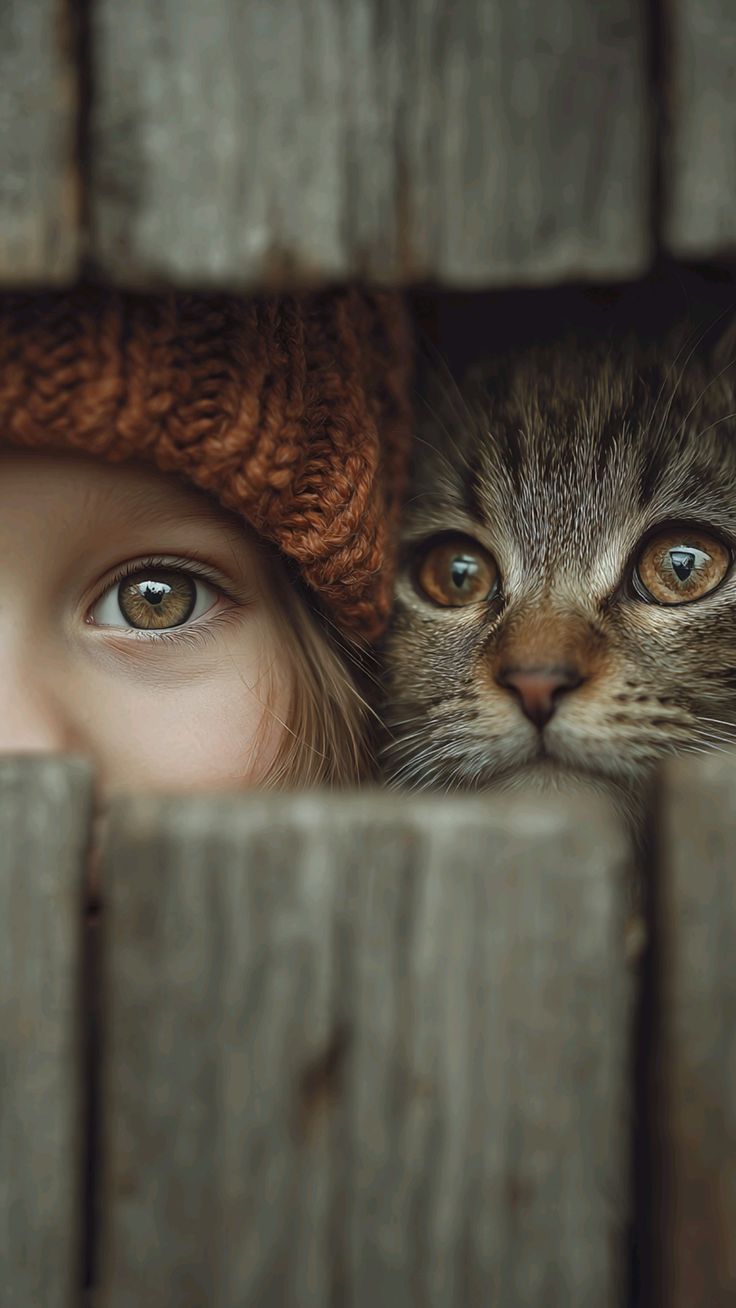
They had the same eyes.
That was the first thing Rosie noticed, the morning she found the kitten hiding in the gap between the old fence boards at the back of her grandmother’s yard. She had been crouching in the cold, her wool hat pulled down over her ears, breath making small clouds in the November air, peering through the weathered slats at the thin strip of alley beyond — the way she always did when the world inside the house felt too large and too loud and she needed something small and manageable to look at. And there, on the other side, looking back at her through the same gap with an expression of identical wariness, was a tabby kitten with amber eyes the precise color of her own.
Rosie was seven years old. She understood about signs.
“Hi,” she whispered.
The kitten did not run. That was notable. In Rosie’s experience, which was admittedly limited but deeply felt, small animals ran from people the way she ran from crowds — instinctively, without deliberation, because the world had taught them that caution was cheaper than trust. But this kitten held its position in the gap between the boards and looked at her with those matching amber eyes as if it were conducting its own careful assessment and had not yet reached a conclusion.
Rosie held very still. She was good at holding still. Her teacher, Ms. Patterson, said she was the quietest child she’d ever taught, which her teacher meant as a concern but which Rosie received as a compliment, the way you receive any accurate description of yourself from someone who doesn’t quite understand why you are the way you are.
She was quiet because the world was loud. That was the whole of it, really.
Her parents had brought her to Grandma Ruth’s house in rural Vermont three weeks ago, in the abrupt and poorly explained way that adults sometimes relocated children — with two suitcases, a hurried conversation in the front seat that stopped whenever Rosie leaned forward, and the specific cheerfulness that grown-ups deployed when they were determined to present something difficult as an adventure. Her mother had stayed four days and then driven back to the city. Her father had not come at all. Grandma Ruth, who smelled of lavender and old books and made oatmeal every morning without asking if Rosie wanted it, which Rosie appreciated enormously, had not offered explanations and Rosie had not asked for them.
She understood, in the wordless way that children understand things that adults imagine they’re successfully concealing, that her parents were in the process of separating their lives. She understood that she was here while that happened. She understood that no one knew exactly how long here would last.
What she did not understand was how to be in a house where everything was unfamiliar, with a grandmother she loved but didn’t quite know yet, in a town where she had no friends and no geography of comfort — no particular tree or corner or library shelf that belonged to her, the way a child needs certain places to belong to them.
The fence was the closest thing she’d found.
She came here every morning with her hat and her quiet and her breath-clouds, and she looked through the gap at the alley beyond, and the gap was exactly the right size — big enough to see through, small enough to feel like a secret, the fence solid on both sides like a frame around the only portion of the world she was currently choosing to pay attention to.
And now there was a kitten.
“You’re cold,” Rosie told it. This was observational rather than sympathetic, though it was both. The kitten was thin — she could see the suggestion of ribs even through the winter coat — and its ears were flat in the way that meant discomfort rather than aggression. It had been outside long enough for the cold to have worked into it. It was not a happy cold. It was an endured cold, the cold of something that had been managing on its own for longer than was ideal.
Rosie related to this.
She reached through the gap slowly, the way she’d read you were supposed to approach animals — low and unhurried, fingers loose, letting the creature decide the terms of contact. The kitten watched her hand arrive with those steady amber eyes and then, after a pause that felt very deliberate, pushed its face against her fingers.
The warmth of it was startling. That small, specific warmth, right there in the cold, against her palm.
Rosie sat with that for a moment.
Then she went inside and got a saucer of milk — she’d read that you weren’t supposed to give cats milk, that it was actually bad for them, but the kitten was small and it was cold and she had milk and no proper cat food, and some principles bend under the weight of a specific and immediate need. She came back and set it on her side of the fence and waited.
The kitten examined the gap. Examined Rosie. Examined the saucer with the precise, unhurried attention of a creature that had learned to evaluate offers carefully before accepting them.
Then it came through.
It ate the milk in small, fastidious laps, and when it was done it sat beside Rosie’s knee and began to wash its face, which Rosie had read meant that a cat felt safe — the washing was a sign of comfort, of the lowering of vigilance, of a creature that had decided, for now, that this was an acceptable place to be.
Rosie put her hand on its back, very gently.
The kitten purred.
She had not cried once since her mother drove away. She cried now, quietly, in the way she did everything — without drama, without sound, just the tears moving down her face in the cold while a small cat purred against her knee and the fence held the world at exactly the right distance.
Grandma Ruth was watching from the kitchen window.
She did not come outside. She understood, the way certain people understand, that some moments need a witness and not a participant.
She went to the pantry instead, and checked what she had, and added kitten food to the list on the counter.
