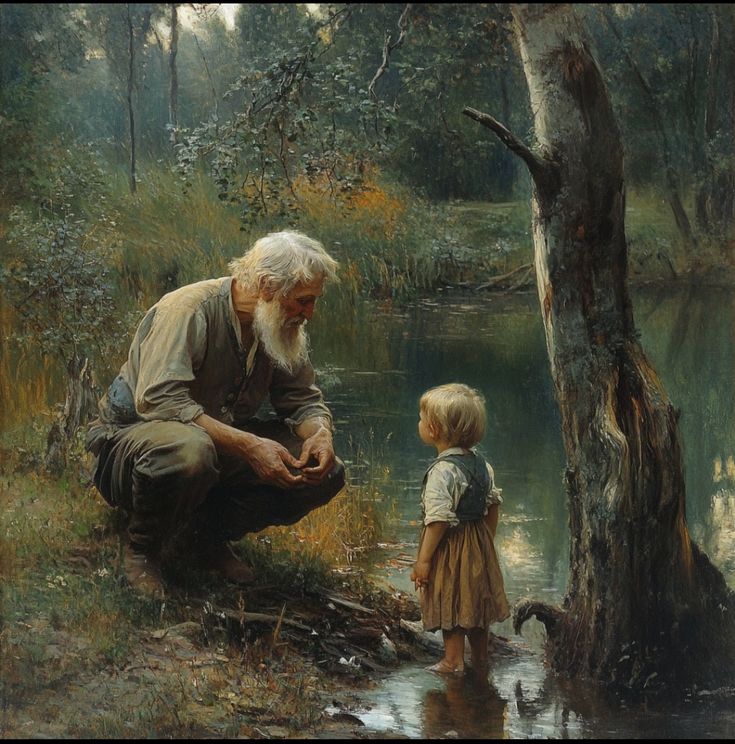
The old man was already at the creek when the child found him.
He came here every morning at the same hour — early enough that the light was still arriving sideways through the trees, turning the water copper and gold, late enough that the birds had stopped their dawn argument and settled into the quieter business of the day. He had been coming to this particular bend in this particular creek for sixty-one years, since he was a young man with straight knees and a full head of dark hair and the mistaken belief that he had all the time in the world for everything that mattered.
His name was Walter Hess. He was eighty-two years old. He had outlived a wife, a son, and the version of himself that had once believed outliving people was something that happened to other families.
He was crouched at the water’s edge, cupping something in his hands, when he heard the small feet in the mud behind him.
He didn’t startle. He had startled easily once, after the war — a car backfiring, a door slamming, and he’d be across the room before he’d made the decision to move, his heart doing something complicated in his chest that took several minutes to undo. That was sixty years ago. He had done the long, slow work of learning to inhabit his own body again, and one of the rewards of that work was that he no longer startled. He simply noticed, and turned, and received whatever the world was sending him.
What the world was sending him today was a toddler, perhaps two years old, standing in the shallow edge of the creek with bare feet and an expression of absolute fascination, wearing a yellow dress with a small stain on the front and the look of someone who had arrived somewhere important and knew it.
He opened his hands slowly, so she could see.
A small frog, green-brown and perfectly still, sat in his weathered palm. It blinked once with those ancient, golden eyes that frogs have — eyes that look borrowed from something much older and wiser than a frog has any right to be.
The child looked at the frog. Then she looked at Walter. Then back at the frog.
“Fwog,” she said, with the solemnity of a scientist confirming a hypothesis.
“That’s right,” Walter said. “Frog.”
He set it down at the water’s edge and they both watched it consider its situation briefly before launching itself, with admirable commitment, back into the creek. The child watched the ripples with an intensity that Walter recognized — the particular attention of someone encountering for the first time something that everyone else has stopped noticing. He had spent a lot of his life trying to get that attention back, once he’d lost it. He was still working on it.
“Where did you come from?” he asked her.
She pointed, vaguely, upstream. Which was not especially informative, but was offered with confidence.
He looked upstream. Through the trees, perhaps a hundred yards back, he could see the corner of the old Morrow property — the farmhouse that had been sold twice in the last decade, standing empty between owners each time, a house that had been waiting for the right family with the patient indifference of old structures that have seen enough families come and go to know that the right one usually arrives eventually. Someone had moved in last week. He’d seen the moving truck from his kitchen window, watched the shapes of people carrying boxes, decided he’d introduce himself when things settled.
He looked at the child in the creek.
He supposed things had settled.
“I’m Walter,” he said. He always introduced himself to children the same way he introduced himself to adults — his full first name, no diminutives, no just call me Walt. His wife Eleanor had teased him about this for forty-three years. She said it was the most formally friendly thing about him, which she meant as a compliment, and he’d taken it as one.
The child considered this information. “Wawa,” she announced.
“Close enough,” Walter said.
He settled himself more carefully on the bank — his knees requiring a negotiation these days that his younger self would have found embarrassing — and the child came and stood beside him at the water’s edge, which she seemed to have decided was simply where she would stand now, beside this old man she had never met, at a creek she had just discovered, in the morning light that was doing extraordinary things to the surface of the water.
They watched the creek together.
This was, Walter reflected, one of the underrated pleasures of children — their capacity for companionable silence. Adults felt the need to fill silence, to justify proximity with conversation, to earn their place beside another person through the expenditure of words. Children sat beside you because they wanted to sit beside you, and that was sufficient reason, and no further accounting was required.
The creek moved. A dragonfly appeared, impossibly blue, and hovered over a still pool near the opposite bank. The child made a sound of pure delight — short and bright, like a struck bell — and reached out her hand toward it across the water, which was too far, which didn’t matter, which was the correct response to a dragonfly regardless of whether you could reach it.
Walter thought about his son, Thomas, who had died at forty-four of the kind of fast cancer that doesn’t give you time to say anything you mean to say. Thomas had been two years old once, standing at a creek, pointing at things that deserved pointing at. Walter had been younger then than the child’s parents were now, and the creek had been the same creek, and the light had done the same things to the water, and he had not understood yet that the correct response to a dragonfly was to reach for it regardless of whether you could reach it.
He understood now.
The child looked up at him — that direct, uncomplicated gaze that only the very young can manage, the look that doesn’t ask permission to see you clearly.
“Wawa sad?” she said.
It was not quite a question. It was an observation, delivered with the accuracy of someone who had not yet learned that you weren’t supposed to say true things out loud.
He thought about lying. Not cruelly — the small, protective lie, the adult reflex of I’m fine, of keeping the difficult interior weather behind the glass where children wouldn’t have to look at it. He thought about it and then decided, for reasons he couldn’t have fully articulated, that this particular child at this particular creek on this particular morning deserved an honest answer.
“A little,” he said. “Sometimes.”
She nodded. This seemed to satisfy her — not the sadness, but the honesty of it, the confirmation that she had read the situation correctly. Then she reached out and put her small hand in his large one, the way children do without premeditation, without strategy, without anything other than the simple conviction that a hand is for holding.
They sat like that until the sound of a woman’s voice calling through the trees reached them — Lily, Lily — and the child, Lily, stood up and turned toward the sound and then looked back at Walter with an expression that he could only describe, later, when he tried to tell this story, as reluctant.
“Wawa come?” she said.
He looked at the creek. At the light doing its morning work on the water. At the place where the frog had launched itself back into its element with such conviction.
“Next time,” he said.
She seemed to accept this as a binding agreement. Then she went, small and certain, back through the trees toward the voice calling her name, leaving Walter at the creek with his old grief and the dragonfly and the simple, stunning fact that a child he’d never met had looked at him and known he was sad and offered him her hand anyway.
He stayed another hour.
He was smiling when he walked home.
