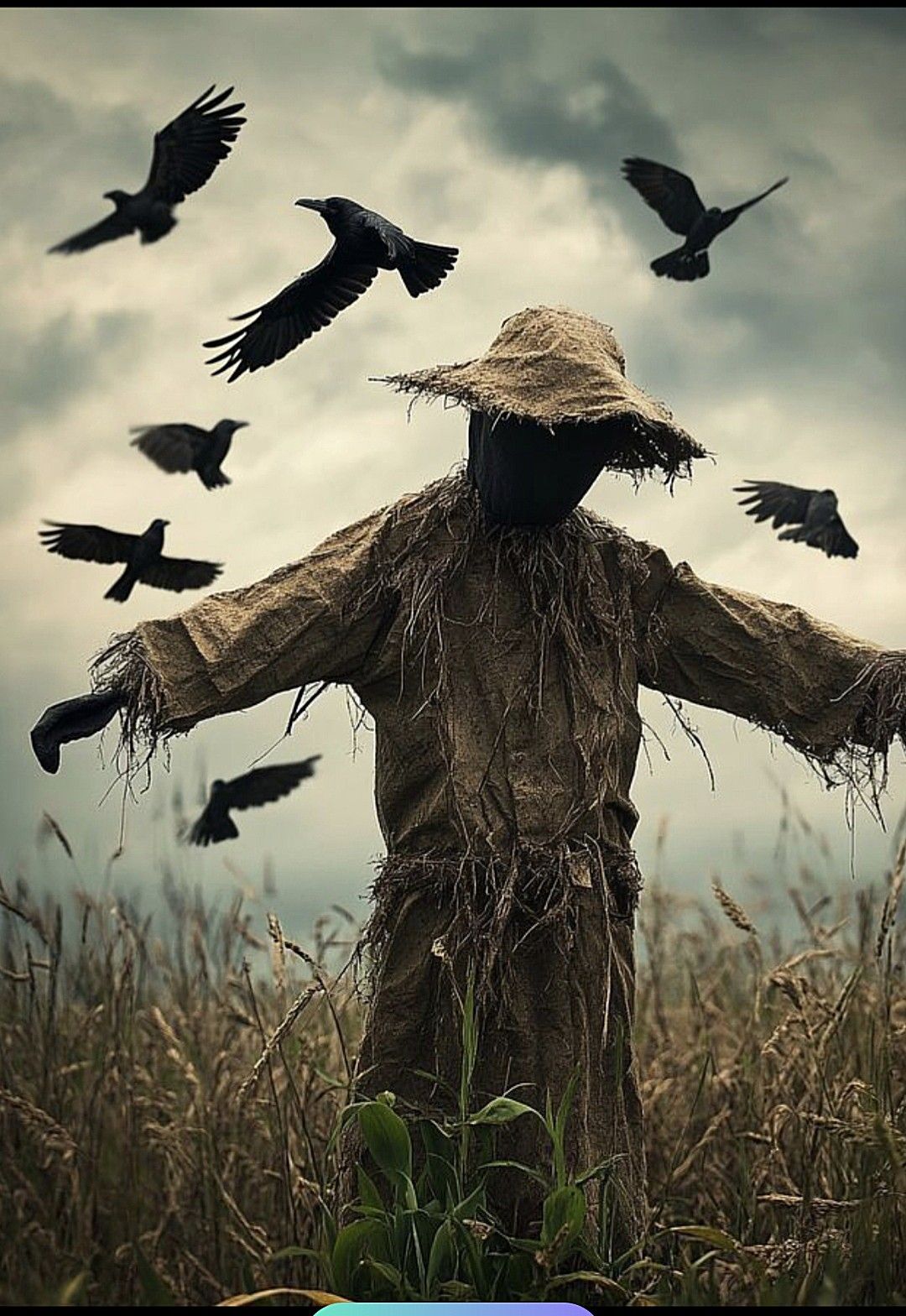
The crows had stopped being afraid of it three years ago.
Earl Pickett noticed this the same way he noticed most things on the farm — slowly, without drama, the way a man notices a fence post leaning before it falls, the incremental shift of something that was once reliable becoming something else. The scarecrow had stood in the east field since his father put it there in 1987, assembled from an old coat and a burlap sack and the particular conviction of a farmer who believed that the old methods worked because they had always worked. For twenty years it had done its job with reasonable competence. The crows kept their distance. The corn came up. The arrangement held.
Then something changed.
Earl couldn’t say exactly when. Only that one autumn he looked out across the east field and saw the crows landing on the scarecrow’s outstretched arms — not cautiously, not with the nervous assessment of prey near a threat, but with the casual comfort of birds that had reached a conclusion about something and were done revisiting it. They sat on it. They groomed themselves on it. One particularly bold individual had taken to perching on its head with the proprietorial confidence of a creature that has claimed a thing for its own.
The scarecrow no longer scared anything.
Earl had replaced the stuffing twice, changed the coat once, added reflective tape that the seed catalog promised would send crows into a panic. The crows had examined the reflective tape with what Earl could only describe as professional interest and then gone back to using the thing as a social venue. He was fairly certain, in the way farmers develop certainties about the animals they live alongside for decades, that the crows had told each other about it — that crow word had spread across whatever communication network crows maintained, that the east field scarecrow had been assessed, classified, and filed under not a threat, decent perching.
He was not entirely wrong.
Crows were, as Earl’s granddaughter Maya had explained to him at considerable length during her last visit, among the most intelligent creatures on the planet. They used tools. They recognized human faces. They held grudges across years and communicated those grudges to their offspring, which meant a crow you’d wronged could ensure that your grandchildren were harassed by its grandchildren in a feud that outlasted everyone who’d started it. They played. They mourned their dead. They made decisions collectively with a sophistication that would be called civilization if a different species were doing it.
Maya was eleven years old and had been telling Earl about crows since she was eight, which was when she’d checked out every crow-related book in the Harlan County library and read them all with the focus of a person who has found, in a particular subject, the thing that makes the world feel organized and sensible.
She loved the east field scarecrow with a devotion that Earl found alternately touching and baffling. She named the crows. She kept a notebook. She had identified, she told him, a hierarchy among the birds that used the scarecrow as their gathering point — certain individuals who arrived first and left last, who seemed to moderate the behavior of others, who were deferred to in the way that authority was deferred to even among creatures that didn’t have a word for it.
The one she called the Judge was the one that worried Earl.
He couldn’t have said why, exactly. He was a practical man — sixty-four years old, three generations of farming in his hands and back and the particular unhurried wisdom of someone who had spent a lifetime reading weather and soil and the behavior of living things in outdoor spaces. He didn’t believe in the supernatural. He believed in what he could measure and plant and harvest.
But the Judge was a crow that sat at the center of the scarecrow’s chest with a stillness that was different from the stillness of other crows, and it watched the farmhouse with a focus that Earl caught himself noticing at odd hours — glancing out the kitchen window while he made his coffee at five in the morning and finding that dark shape precisely where it had been the night before, oriented toward the house with an attention that felt less like observation and more like study.
He didn’t mention this to Maya. She would have been delighted. He wasn’t sure he wanted to delight anyone about it.
The thing that happened on the third Tuesday of October changed the nature of the conversation entirely.
Earl was driving the tractor along the north edge of the east field when he saw Maya standing at the base of the scarecrow, looking up at it, absolutely still. This was not unusual — she visited the scarecrow the way other children visited friends, with regularity and evident pleasure. What was unusual was the circle of crows on the ground around her. Not on the scarecrow. On the ground, arranged in a loose ring perhaps eight feet across, all of them oriented inward, all of them watching the child in the center with that collective crow attention that Earl was increasingly unable to describe without words he didn’t want to use.
He cut the tractor engine.
In the sudden quiet, he heard Maya speaking — softly, steadily, in the focused murmur of someone conducting a conversation they had been having for a while.
He couldn’t hear the words. But he could hear the pauses. The places where she stopped, and waited, and then continued — as if she were taking turns.
As if something were answering.
The Judge sat at the center of the scarecrow’s chest and watched Earl with those dark, ancient, unreasonably intelligent eyes, and Earl sat on his tractor at the edge of the field and watched back, and the clouds moved over the grain in the October light, and nobody on the farm that afternoon was entirely comfortable with what they were seeing.
Earl had farmed this land for forty years.
He had never once been afraid of it.
He drove back to the house, went inside, and called his daughter in Cincinnati.
“Tell me again,” he said, “about the crows.”
