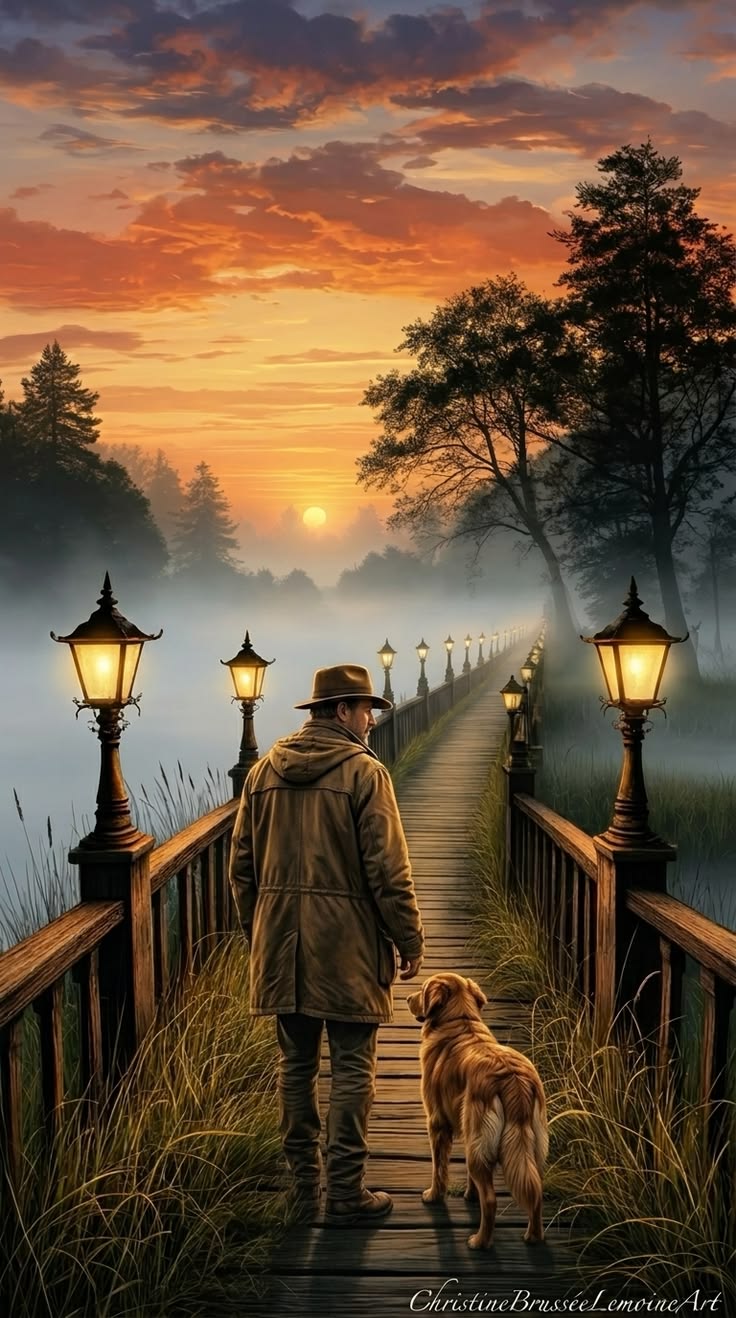
Thomas Hale had walked to the bridge every morning for thirty-one years.
It had started as Ruth’s idea. She was the one who loved early mornings, who believed that the first light of day was God’s way of offering humanity a second chance, fresh and unconditional, every single time. She would pull on her coat before the coffee had finished brewing, lace her boots with the efficiency of a woman who had no patience for sleeping in, and say the same thing she always said: “Tom. The sun won’t wait.”
And Tom, who had been a man of routines long before he became a man of grief, had followed her. Every morning. Through thirty-one winters and thirty-one springs, through the fog that rolled off Heron Lake like something breathing, through the mornings that were so beautiful they made your chest ache and the mornings that were gray and blank and asked nothing of you.
Ruth had been gone fourteen months now. Cancer, the quiet kind, the kind that introduces itself too late for proper argument.
Tom still walked to the bridge.
Copper had shown up on the porch seven weeks after the funeral — a Golden Retriever of indeterminate age with muddy paws and no collar and the absolute confidence of an animal who has selected its person and considers the matter settled. Tom had put up flyers. He had called the shelter. He had told the dog, firmly, on three separate occasions, that he was not in a position to be responsible for another living thing.
Copper had listened to all of this with great patience and then continued sleeping on Ruth’s side of the porch.
Tom stopped arguing on the fourth week.
Now Copper walked beside him every morning to the bridge — not ahead, not behind, but beside, matching Tom’s pace with the attentiveness of a creature who understood that this walk was not really about exercise. The dog never pulled at the leash. He seemed to know, instinctively, that Tom needed the slowness. That the whole point was the slowness.
This particular morning, the fog was thick off the lake, the kind that muffles sound and makes the world feel private. The lanterns on the bridge — old iron ones that the town had maintained for as long as anyone could remember — glowed amber against the gray, casting pools of warm light on the worn wooden planks. Tom stood at the entrance to the bridge and did what he always did: he stopped, put his hands in his coat pockets, and looked toward the sun.
It was rising angry and beautiful, all copper and red above the tree line, burning through the mist with the stubbornness of something that refuses to be dimmed.
Copper pressed against his leg.
Tom exhaled.
He was sixty-four years old. He had been a high school history teacher for thirty-two years in Millhaven, Tennessee, a town small enough that he had taught the children of his former students. He had coached junior varsity baseball for a decade, badly. He had built a porch addition onto their house the summer he turned fifty, and it had leaned slightly to the left for fourteen years, and Ruth had loved it unreservedly, the way she loved most of his imperfections — not despite them, but almost because of them.
He missed her the way you miss a limb. Not metaphorically. Physically. There was a sensation of absence on his left side, where she used to walk, that no amount of time had yet filled.
The grief counselor in Nashville — his daughter Diane had insisted, and Tom had gone twice before deciding that talking to a stranger about Ruth felt like a betrayal of something private — had told him that grief was not linear. Tom had nodded and driven home and never gone back. He understood grief just fine. What he didn’t understand was what came after it. What a person was supposed to become on the other side.
He took one step onto the bridge. Then another. The planks were damp with morning dew, and they creaked the way old things creak — not with complaint, but with character. Copper walked beside him, nails clicking softly on the wood.
Halfway across, Tom stopped. He always stopped here. It was the spot where, on their first morning walk thirty-one years ago, Ruth had grabbed his arm and said “Look” in the particular urgent way she had, the way that brooked no distraction, and when he looked he had seen a great blue heron standing motionless in the shallows below, prehistoric and perfect, unbothered by the world.
They had seen herons from this spot dozens of times after that. It had become a kind of private ceremony — standing here, looking down, waiting.
This morning the water was hidden in fog. He couldn’t see the shallows. He couldn’t see much of anything below the bridge.
He stood anyway.
Copper sat down beside him, pressed his warm flank against Tom’s calf, and looked up — not at the water, not at the fog, but at Tom. The way dogs look at you when they’ve decided you are the most important thing in the landscape.
Tom looked down at him. The dog’s eyes were gold in the lantern light, patient as sunrise.
“I don’t know what I’m doing, buddy,” Tom said. He hadn’t meant to say it out loud. His voice came out rougher than expected, scraped by something.
Copper put his head against Tom’s knee.
The sun broke fully above the tree line then, burning the fog back in layers, and the lake appeared beneath them — silver and vast and quietly alive — and standing in the shallows, exactly where it always stood, was the heron.
Tom’s breath caught.
He stood there for a long time, the dog against his leg, the heron below, the sun climbing, the lanterns burning gold on either side of him like something lined up on purpose.
Like something that had been arranged.
He took off his hat. He didn’t know exactly why. It just felt right.
“Okay, Ruth,” he said softly. “I’m still here.”
