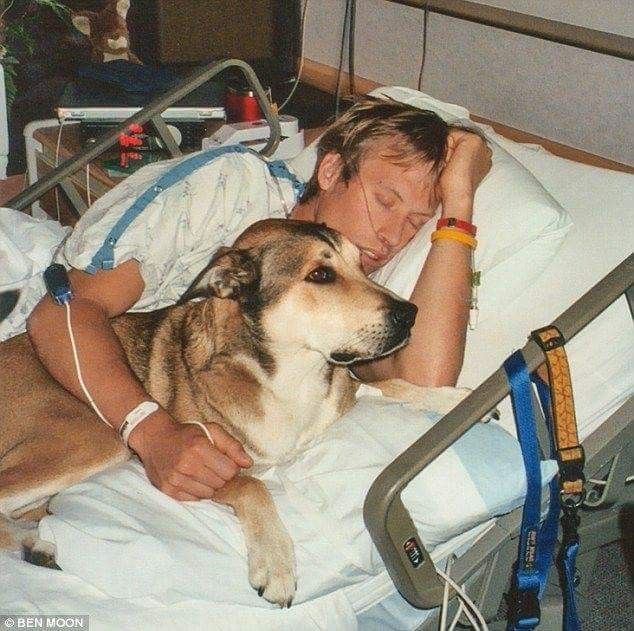
The beeping was the first thing Ben Calloway heard when he came back to consciousness — a steady, indifferent rhythm that told him his heart was still working even when the rest of him had stopped caring whether it did or not. The hospital ceiling was white and featureless, the kind of blank that gives a person too much room to think. He was thirty-one years old, he had a tumor wrapped around his colon like a fist, and the surgeon had used the word aggressive four times in one conversation without once looking him in the eye.
He had no wife. His parents were in Oregon, three states and a complicated history away. His friends — the good kind, the ones who showed up — were scattered across a country that moves fast and forgets faster.
But sometime in the late afternoon of his third day in the ICU, a nurse named Priya did something that bent every rule in the hospital’s policy handbook.
She brought in the dog.
Kodak was a German Shepherd mix, seven years old, seventy-one pounds of quiet loyalty with a gray muzzle that had come in earlier than it should have. Ben had found him at a rescue shelter in Portland six years ago — a dog nobody wanted because he was too calm, too serious, not bouncy enough for families with kids who wanted a dog like a cartoon. But Ben had been looking for exactly that: a companion who didn’t need to perform happiness. A dog who would simply be there.
And Kodak had been there. Through the breakup with Claire. Through the cross-country move. Through the three months Ben spent unemployed, eating cereal for dinner and applying for jobs in the dark. Kodak had pressed his warm weight against Ben’s legs every single night, as if to say: I am an anchor. Hold on.
When the diagnosis came, Ben’s first thought — before fear, before grief, before the logistics of insurance and surgery and leave of absence — was: Who will take care of Kodak?
He hadn’t eaten well in weeks. He’d lost nineteen pounds before the hospital stay. The tumor had been growing quietly, the way catastrophes do, while Ben worked sixty-hour weeks at the architecture firm and told himself the stomach pain was stress.
By the time they found it, the word stage was followed by a number that made the room tilt.
Nurse Priya had a policy of bending policies. She had worked oncology for eleven years and had developed a precise internal instrument for knowing when the medicine wasn’t enough — when what a patient needed wasn’t another IV adjustment or a pamphlet about nutrition, but something that the hospital formulary simply didn’t carry.
She had seen the photo on Ben’s bedside table. A man and a dog on a mountain trail, both of them squinting into the sun, both of them looking like they belonged exactly where they were.
She had made a phone call to Ben’s neighbor, Carol, who had been keeping Kodak. She had said: Bring him tomorrow. Use the service entrance. Ask for me.
Carol, who was sixty-seven and had once chained herself to an old-growth tree to stop it from being cut down, did not need to be asked twice.
Kodak entered the room without drama. He didn’t bark. He didn’t jump. He walked to the side of Ben’s hospital bed with the focused deliberateness of someone who had been given a job and intended to do it properly. He put his front paws up, assessed the situation with those amber eyes, and then — carefully, as if he understood the tubes and the monitors and the fragility of everything — he climbed up and lay down beside Ben, his heavy head resting on Ben’s chest.
Ben hadn’t cried yet. Not at the diagnosis. Not when they wheeled him into surgery. Not when he woke up in recovery and had to piece together, slowly and terribly, where he was and why.
He cried now.
Not the panicked crying of fear, but the slow, releasing kind — the kind that means something locked has finally opened. He pressed his face into the warm fur of Kodak’s neck, and Kodak made a low sound, not quite a whimper, more like an acknowledgment. I know. I’m here. I’ve got you.
The monitors kept beeping. Outside the window, Portland went about its business. Inside room 414, a man and his dog held each other in the particular silence of unconditional love — the kind that asks nothing, explains nothing, and requires no words to be completely, perfectly understood.
Priya checked on him twenty minutes later and found them both asleep.
She documented it in her private notes, the ones she kept in a journal at home: Patient resting. Heart rate down. First real sleep in four days. The dog stayed.
Ben would undergo two more surgeries. He would do six months of chemotherapy that made him feel, on his worst days, like his body was a building being demolished from the inside. He would lose his hair and some of his confidence and a few friends who didn’t know how to be present for suffering.
But Kodak came back every week. Carol brought him every Thursday, through the service entrance, past the desk where Priya worked, into room 414 where Ben was fighting the long, ugly, unglamorous fight that nobody talks about when they use the word brave.
He made it. Remission, fourteen months after diagnosis. The surgeon — the one who never made eye contact — actually smiled.
On the day Ben walked out of the hospital for the last time, Kodak was waiting in the parking lot with Carol. The dog saw him and did something he had never done before.
He ran.
