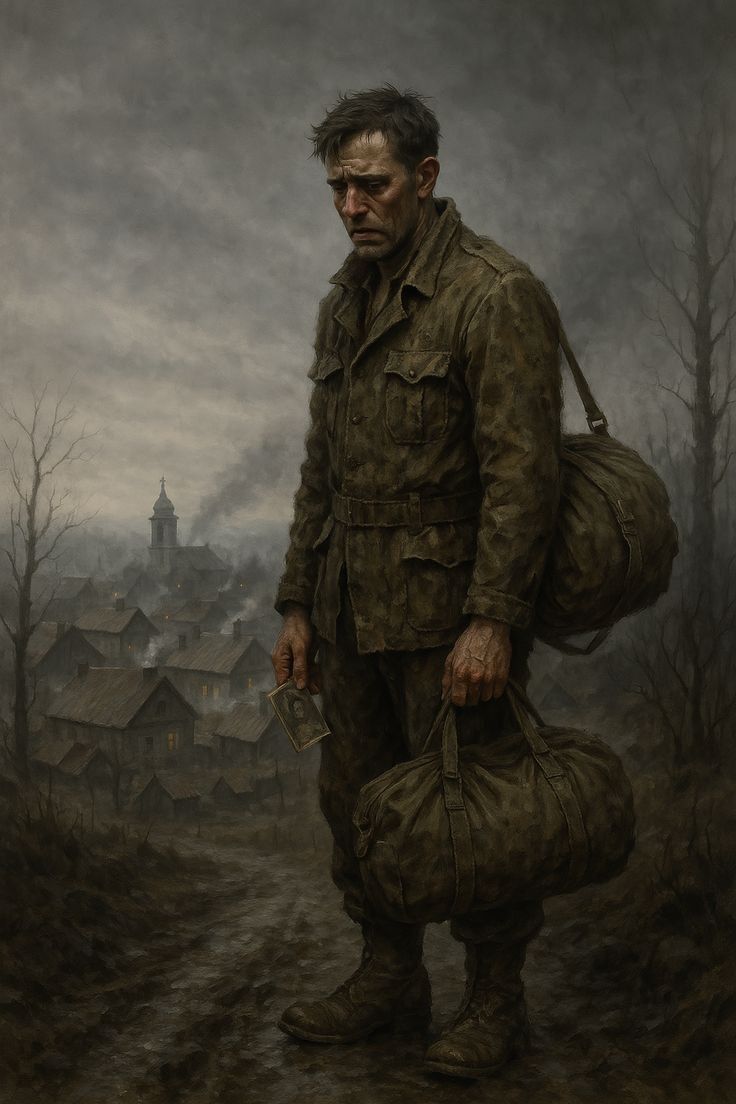
He had survived things that had no business being survived.
That was the thought that accompanied James Calloway down the dirt road into Harlan’s Creek, Kentucky — the same road he had walked out of fourteen months ago with a duffel bag and a set of orders and his mother’s hand pressed against his face for three seconds longer than either of them could bear. He had survived the desert heat and the roadside bombs and the specific, unrepeatable horror of watching men he loved become past tense between one breath and the next. He had survived the field hospital and the infection and the three weeks he didn’t fully remember that the doctors referred to with careful clinical language designed to create distance from what had actually happened.
He had survived all of it and come back to Harlan’s Creek on a gray November morning with his two duffel bags and his discharge papers and a photograph — worn soft at the edges from handling, the way photographs get when they’ve been the only thing standing between a man and the dark — held in his right hand.
The photograph was of a woman and a boy. The woman was his wife, Carol. The boy was his son, Eli, who had been two years old when James left and was now three and a half and would not, James understood with a grief both clinical and devastating, remember him.
The town looked the same. That was the first shock — that the world he had left behind had simply continued, unchanged and indifferent, while the world inside him had been rearranged beyond recognition. The church steeple, the Miller’s hardware, the grain elevator at the edge of town. All of it exactly where he had left it, wearing the same gray November sky as if fourteen months were nothing at all.
James Calloway, thirty-one years old, decorated and discharged and deeply, privately unmoored, stood at the edge of his hometown and could not make his feet move forward.
He had not told Carol exactly when he was coming.
This required explanation, and the explanation was not simple. It was not that he didn’t want to see her — he had wanted nothing else for fourteen months, had held the wanting of it like a coal in his chest, something that burned but also kept him warm. It was that he had spent fourteen months becoming someone that the James who left Harlan’s Creek would not entirely recognize, and he did not know how to walk back into his own life without first standing at its edge and taking account of what he was bringing with him.
What he was bringing with him was considerable, and not all of it was in the duffel bags.
He was bringing the nightmares that came three, four times a week — not always the same, but always loud, always ending with him rigid in the dark, heart at combat rate, reaching for a weapon that wasn’t there and then slowly, over the course of sixty seconds that felt much longer, reconstructing where he was and that he was safe. He was bringing the hypervigilance that made restaurants unbearable, that put him with his back to walls and his eyes on exits, that heard a car backfire and sent his body somewhere his mind couldn’t immediately follow. He was bringing the silences that had grown in him overseas — long, deep silences that Carol’s last three phone calls had noted with a concern she tried hard to keep casual and he tried hard to explain and neither of them had managed well.
He was also bringing — and this was the part that the VA paperwork and the clinical language didn’t have adequate room for — a love for his wife and son so concentrated by fourteen months of potential loss that it had become almost unbearable to hold. The kind of love that absence distills into something pure and urgent and terrifying in its intensity.
He stood in the mud of the road and held the photograph and breathed the cold Kentucky air and gave himself sixty seconds to be afraid.
Then he picked up the bags and walked.
The light was on in the kitchen. He could see it from the road — the warm yellow rectangle of it against the gray morning, the most beautiful thing he had seen in fourteen months, which was saying something because he had seen sunrises over foreign deserts that had briefly made him believe in things he’d stopped believing in.
He stood at the gate of the yard he had built himself, the fence he had put in the summer before Eli was born, white paint now weathered to the color of old bone. The gate latch was the same. His hand remembered it.
Inside, he could see movement through the kitchen window. Carol, her hair different — shorter than he remembered — moving with the competent efficiency of a woman who had spent fourteen months being both parents and had gotten very good at it. A fact that filled him with simultaneous pride and a shame he knew was irrational and felt anyway.
And then a smaller shape. Running. The distinctive running of a three-year-old, all forward momentum and faith, the body not yet acquainted with the possibility of falling.
Eli.
James’s hand tightened on the gate latch. His throat closed entirely.
The boy stopped at the kitchen window. Pressed his face against the glass the way children do — nose flat, breath fogging the cold pane — and looked out at the gray morning.
Looked directly, it seemed, at the man standing at the gate.
James raised his hand. A slow wave. Not sure if the boy could see him. Not sure of very much at all.
Eli pulled back from the window. James heard, faintly through the glass, a single word — the word a three-year-old uses in the specific urgent register of someone who has just seen something that requires immediate parental attention.
“Mama.”
