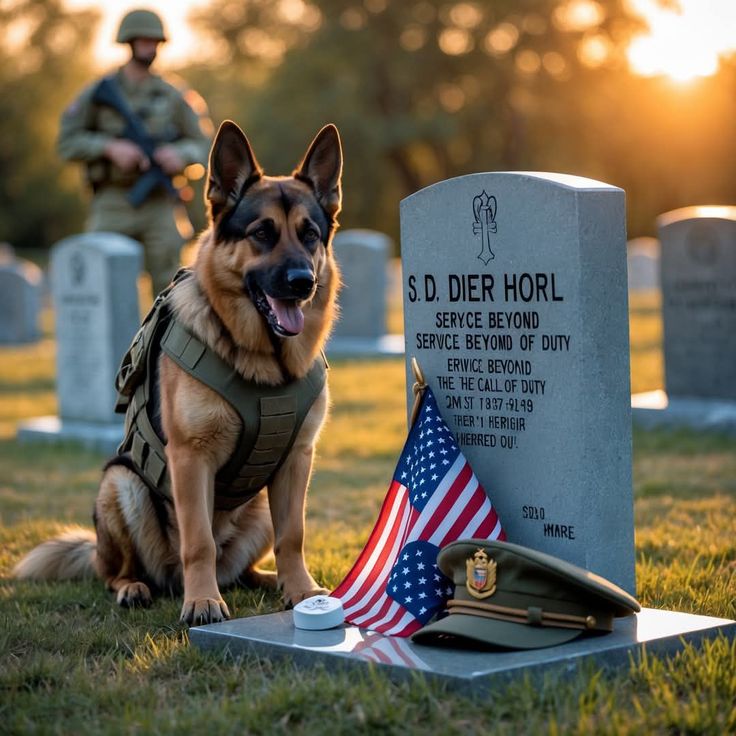
The sun came down gold and low over Arlington every evening at this hour, the kind of light that made the white stones look like they were glowing from inside, lit by something more than reflected sun. Thousands of markers, row upon perfect row, each one a name, a date, a life that had been offered up and accepted by a country that would spend the rest of its existence trying to be worthy of the offering.
Sergeant Rex didn’t understand any of this in the way a person understands things.
He understood it in a different way — a deeper way, perhaps, the way dogs understand the things that matter most. With his whole body. With the ancient, reliable instrument of his loyalty, which had been calibrated to one specific frequency for six years and had not stopped transmitting simply because the signal had gone quiet.
He sat at the stone the way he had sat at it every day for eleven months. Straight. Alert. Ears forward. Tactical vest still fitted to his seventy-eight-pound frame because the handlers who cared for him now had learned, through two attempts to remove it, that Rex did not accept its absence with any equanimity. The vest had been his partner’s decision — Staff Sergeant Daniel Howell had fitted it to Rex the morning of their first deployment and had made the same small adjustment to the left strap, the same precise tug, every single morning for six years as a kind of ritual, a kind of conversation between a man and his dog that required no words.
Rex still wore it. He would wear it until someone could explain to him, in terms he could accept, why he shouldn’t.
No one had managed that yet.
Daniel Howell had been many things before he became a name on a stone in Arlington.
He had been a kid from Macon, Georgia who could fix any engine ever made and had the patience of stone water and laughed at his own jokes before he finished telling them. He had been a son — his mother Margaret’s particular pride, her oldest, the one who called every Sunday without fail for eleven years of service, whose calls she had structured her Sundays around the way you structure life around the things that sustain it. He had been a friend, a brother, a Staff Sergeant who his unit would tell you — quietly, in the specific registers that soldiers use when they are telling you something that the official record doesn’t fully capture — was the kind of man who made other men want to be better than they thought they could be.
He had been Rex’s partner for six years. This was, in the accounting of loyalties, the one that Rex kept.
They had served together in two countries and four forward operating bases and a number of situations that existed in classified files and in the specific, indelible memories of the men who had been there. Rex had found what needed finding. Daniel had trusted what Rex told him — completely, without hesitation, the kind of trust that can only be built in conditions where the cost of distrust is immediate and irreversible.
They had saved each other. More than once. In ways that made the accounting of who owed whom impossible and beside the point.
The IED had been on a road that had been cleared. This is the particular cruelty of certain losses — not just that they happen, but that they happen on roads that were supposed to be safe, in moments that were supposed to be routine, when the worst has presumably already been survived and the mind has permitted itself, briefly, to believe in the next thing.
Rex had not been with Daniel that morning. This was the fact that his current handlers understood kept the dog awake some nights — lying on his side in the kennel with his eyes open, processing something in the ancient circuitry of an animal who knows, at a level below conscious thought, that he was built for one purpose and that purpose had been permanently interrupted.
He had been built to keep Daniel Howell alive. He had failed. That the failure was not his fault was a human distinction that Rex could not access and would not have found comforting if he could.
Margaret Howell came on Sundays. She had restructured her Sundays again — around a different fixed point now, the same boy, a different kind of presence. She would arrive at ten, after the morning crowds thinned, and she would sit in the folding chair she brought herself and talk to the stone the way she had talked to the phone on Sunday mornings for eleven years. Telling Daniel about the week. The neighbors. His sister’s kids. The garden, which she maintained with the same dedication she maintained everything connected to him.
When Rex heard her coming — he always heard her before she was visible, had her footsteps catalogued and recognized from thirty yards — he would stand. Not from his sitting position into a casual stand, but into the full attentive stand of a working dog acknowledging someone of significance. His ears would come fully forward. His tail would move — not the exuberant tail of a pet greeting a visitor, but the slow, deliberate movement of an animal expressing something more complicated than simple happiness.
Margaret would sit beside him. She would put her hand on his back, between his shoulder blades, and he would lean into it — slightly, just slightly, exactly as much as a dog maintains while still holding himself in working posture.
She talked. He listened. Around them the gold light moved across the stones and the flags turned in the small wind and the soldier standing guard at the edge of the section held his position with the stillness of someone who understands what stillness costs and pays it anyway.
One Sunday Margaret had said, to the stone, to the dog, to whatever combination of them constituted the audience she needed: “He always said you were the best partner he ever had. He said you understood things people couldn’t.”
Rex had turned and looked at her then. Directly. The amber-eyed, full-attention look of a dog bringing everything it has to a single moment.
Margaret had put her hand on his face. Neither of them had moved for a long time.
The stones stretched in every direction, silent and necessary, holding names the country was obligated to remember.
Rex held his.
