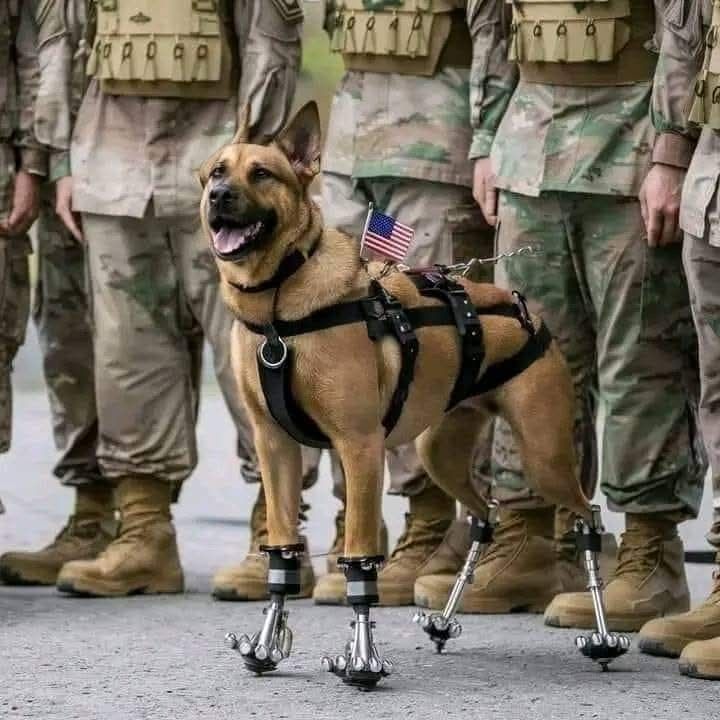
The morning they fitted Sergeant Atlas with his prosthetics, there wasn’t a dry eye on the base.
That was the part nobody talked about afterward — not officially, not in the press release the Army’s public affairs office put out, not in the carefully worded commendation that used words like valor and distinguished service and exceptional performance in the measured language of institutions that are better at honoring sacrifice than acknowledging the specific human — and animal — cost of it. The press release mentioned the prosthetics. It did not mention Corporal Danny Reyes standing in the back of the room with his jaw working and his eyes fixed on the ceiling the way men fix their eyes on ceilings when they are determining whether they are going to hold it together or not.
Danny had been Atlas’s handler for four years. He knew every sound the dog made, every shift of his weight, every signal in the vocabulary of a Belgian Malinois who had been trained to operate in conditions that would disable most human soldiers. He knew the small whine Atlas made when he was working a scent he was close to. He knew the particular way the dog’s ears moved — independently, like radar dishes — when he heard something worth hearing. He knew that Atlas slept on his left side and had a preference for the spot near the bunk where the heating vent blew warm and that he had, on three separate occasions, detected threats that the best electronic equipment the United States Army possessed had failed to find.
He knew Atlas. And watching Atlas take his first steps on four titanium-and-carbon-fiber prosthetic limbs — cautious, then less cautious, then with a gathering confidence that broke something open in everyone in that room — Danny Reyes understood something about courage that he would spend the rest of his life trying to put into words.
The IED had been on a road in Kandahar Province that they had swept twice.
This was the fact that lived in Danny’s chest like a splinter — not the explosion itself, not the noise or the force of it, but the twice. They had swept it twice. Atlas had swept it twice. The device had been buried in a culvert beneath the road surface at a depth and with a construction specifically designed to defeat detection, the work of people who had studied military dog teams with the same professional attention that the military brought to studying them.
Atlas had found eleven devices in four years. This one had found him first.
The explosion took both front legs below the knee and the rear right leg at mid-limb. The fact that it did not take more — did not take Atlas entirely, did not take Danny, who was six feet behind him — was the kind of arithmetic that military personnel learn not to examine too closely because the variables that produce survival over non-survival are too random to sustain belief in a rational universe.
Atlas had been alive. That was the number that mattered. Badly injured, in acute distress, requiring emergency veterinary intervention that the unit’s medic and a forward surgical team provided with the same focus and speed they would have brought to any member of the unit, because Atlas was a member of the unit — E-7, Staff Sergeant, with the pay grade and the service record to prove it — and that designation was not ceremonial.
Danny had held his head during the initial treatment. Talked to him the whole time. Nonsense, mostly — the kind of continuous low-voiced stream of words that experienced handlers use to maintain connection with a dog in crisis, to be the anchor point that tells the animal’s nervous system: you are not alone in this, I am right here, stay with me.
Atlas had stayed.
The prosthetics had been developed by a team at a veterinary biomechanics lab in Colorado that had been working on the problem of animal limb loss with the specific urgency of people who understand that military working dogs are not equipment — a classification the Army officially abandoned in 2000 when MWDs were reclassified from property to canines, a distinction that everyone who had ever worked alongside one of them found about forty years overdue.
The fittings had taken three months. Each prosthetic was custom-fabricated to Atlas’s specific anatomy, gait pattern, and weight distribution. The process had required patience from the veterinary team and a different kind of patience from Atlas, who had submitted to the repeated fittings and adjustments with the focused cooperation of an animal that seems, somehow, to understand that the humans around him are trying to help even when helping requires discomfort.
Danny had been present for every session. This was not officially required. He was there anyway.
The first time Atlas walked on all four prosthetics without assistance, he walked directly to Danny.
Not to the veterinary team. Not to the base commander who had come to observe. Not toward the open door and the outside air, which dogs generally prioritize.
To Danny. Across the room. Eleven steps on new legs, each one a small negotiation with physics and balance and the entirely new information his nervous system was processing, and at the end of the eleven steps he sat — the formal working sit, the one that means I am here, I am ready, tell me what we’re doing next — and looked up at Danny with the amber-eyed, full-attention regard that had been Danny’s to receive for four years.
Danny went down on one knee. He put both hands on either side of Atlas’s face. The dog’s tail moved.
“Good boy,” Danny said. His voice was completely level. He was from San Antonio, Texas, and he had been raised in a tradition that did not make public exhibitions of certain things.
“Good boy,” he said again, and this time his voice was not level at all, and he stopped trying to make it so.
Around them, twelve soldiers found reasons to look at other parts of the room. The veterinary team became very interested in their equipment. The base commander cleared his throat twice.
The American flag on Atlas’s harness caught the fluorescent light and held it.
Six weeks later, Atlas stood in formation.
Full dress. American flag on his harness. Prosthetics polished to the standard that the unit held for boots and brass — because if Atlas was in formation, Atlas was in uniform, and uniform meant standards, and standards were not suspended for injury or difficulty or anything else the military had a word for.
He stood between Danny on his left and Sergeant First Class Maria Okafor on his right, and he stood straight, and he stood still, and he stood with the particular quality of presence that certain individuals — human and otherwise — carry into a room, the quality that makes others stand a little straighter without quite knowing why.
The commanding officer walked the line. When he reached Atlas he stopped. He looked at the dog for a moment — really looked, the way busy people rarely take time to look at things.
Then he said, to the unit, to the dog, to no one and everyone: “This is what it looks like. Right here. This is exactly what it looks like.”
Nobody asked what he meant. Everyone knew.
