The morning of the wedding had been perfect — or so everyone pretended.
Elena stood in front of the mirror in the small upstairs bedroom of the Volkov family home, her white dress cascading to the floor like fresh snow, her veil pinned delicately into dark curls that her mother had spent two hours perfecting. She was beautiful. Everyone said so. The photographer had already taken thirty pictures of her just standing there, doing nothing but existing in that dress, in that light, on that morning.
But beauty, Elena had learned, was never enough for Irina Volkov.
Her mother-in-law — soon to be her mother-in-law, in a matter of hours — stood behind her in the reflection. Irina was a tall woman, angular and precise, the kind of woman who ironed her tablecloths twice and noticed when a spoon was placed a centimeter out of alignment. She wore a deep burgundy dress that cost more than Elena’s first month’s salary, and she held a glass of sparkling water as though it were a weapon she hadn’t yet decided to use.
“Your lipstick,” Irina said, “is too red.”
Elena met her eyes in the mirror. “Dmitri chose it.”
“Dmitri,” Irina replied, “has always had poor taste in certain things.”
She didn’t say certain things the way someone says a phrase. She said it the way someone places a knife on a table — slowly, deliberately, making sure you see the blade.
Elena turned from the mirror. The other women in the room — her cousin Vika, the seamstress who had stayed to make final adjustments, an aunt whose name Elena always forgot — all found something very interesting to look at in the corners of the ceiling.
“Irina Semyonovna,” Elena said, keeping her voice calm, “today is my wedding day.”
“I’m aware of what day it is.”
“Then perhaps today could be a day when we—”
“I want to show you something.” Irina set her glass down on the windowsill and reached into her small handbag. She produced a photograph — old, slightly faded, printed on the thick paper of a decade past. She held it out to Elena without walking closer, making Elena come to her.
Elena took the photograph.
It was a young woman in a wedding dress. Not her dress. A simpler dress, long-sleeved, modest, almost austere. The woman was pretty in a quiet, unassuming way. She stood in front of a church Elena didn’t recognize, alone, holding a bouquet of white roses.
“Who is this?” Elena asked.
“That is Natasha Belinskaya. She was Dmitri’s girlfriend for four years. Before you.”
Elena looked at the photograph for a moment longer, then handed it back. “I know who Natasha is.”
“Then you know she was suitable. Her family—”
“I know her family.” Elena’s voice had gone very still. “I also know that Dmitri left her. He left her and he found me. That was his choice.”
“He was young. He didn’t know what he was choosing.”
“And now? He’s twenty-nine years old and he’s standing downstairs in a suit waiting to marry me. Is he still too young to know?”
Irina’s eyes narrowed by the smallest fraction. It was the closest she ever came to showing that something had landed.
“You are a pretty girl, Elena,” she said. “I won’t deny that. You dress well. You speak well enough. You have made my son smile in ways I haven’t seen since he was a child.” She paused. “But pretty girls with good smiles have a way of becoming something else once the wedding is over. Once they are inside the house. Once they are comfortable.”
“What kind of something else?”
“Demanding. Territorial.” Irina smoothed the front of her burgundy dress. “My son built his life before you arrived. His habits, his schedule, his relationship with his family. These are things you will be expected to respect.”
“I do respect them.”
“You say that now.”
“I’ll say it tomorrow too. And the day after.”
Irina took a step closer. She smelled of expensive perfume and something underneath it — something colder, like the particular chill of a room that hasn’t been opened in years.
“Let me be direct with you, since we are women and we have only a few minutes before this circus begins.” Her voice dropped. “You are marrying my son. You are not marrying this family. Whatever romantic ideas you have about holidays together, about closeness, about becoming a daughter to me — let them go. I already have a family. I don’t need additions. I need my son to remain the person he has always been, and I need his wife to understand her place in that arrangement.”
The room had gone so quiet that Elena could hear the music starting somewhere downstairs. A string quartet her parents had hired, playing something gentle and hopeful and completely unaware of what was happening one floor above them.
Elena looked at this woman. She looked at her for a long moment — at the set of her jaw, the controlled coldness of her eyes, the way she held herself like someone who had never in her adult life been told no and accepted it gracefully.
And something shifted inside Elena. Not broke. Not crumbled. Shifted — the way a foundation shifts when it’s settling into something permanent, something immovable.
“You just told me,” Elena said quietly, “that I am marrying your son and not this family. Then with respect, Irina Semyonovna, what happens between me and Dmitri is between me and Dmitri. And what happens in our home will be for us to decide. Both of us.”
Irina’s expression didn’t change. But her chin lifted, and her next words came out with the particular sharpness of someone accustomed to having the last word.
“You think love protects you,” she said. “It doesn’t. Love is the first thing to go.”
And then she reached out.
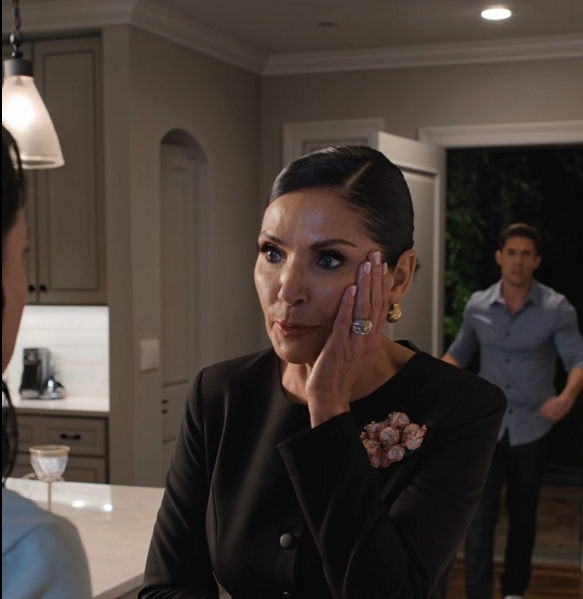
It happened fast — faster than Elena’s brain could process the intention behind it. Irina’s hand came up and across, and the slap connected with Elena’s cheek with a sound that was somehow both small and enormous — a sharp crack that seemed to bounce off every wall of the room simultaneously.
Elena’s head turned with the force of it.
Nobody moved.
The cousin, Vika, made a sound like a word that died before it became one. The aunt put her hand to her mouth. The seamstress took a small, involuntary step backward.
Elena stood very still.
Her cheek burned. She could feel the exact shape of Irina’s fingers on her skin, the heat spreading outward like something being branded. Her eyes filled — not from sadness, not quite, but from the pure physical shock of it, the body’s automatic response to impact.
She did not cry.
She turned her face back to Irina Volkov and looked at her directly, and the look she gave her was something Irina had perhaps never received in her entire life: not hatred, not fear, not even anger.
Pity.
It was the worst thing Elena could have offered her, and somewhere in Irina’s eyes, just for a fraction of a second, she knew it.
Dmitri Volkov had been standing at the bottom of the stairs for approximately forty seconds when he heard it.
He didn’t know, immediately, what the sound was. He turned toward the staircase with his head tilted, the way a person does when they hear something that doesn’t fit the context of the moment. His best man, Sasha, turned too. The photographer, who had been checking his equipment near the window, looked up.
Then Vika appeared at the top of the stairs.
Vika was twenty-four years old and had spent her entire life being the kind of person who avoided confrontation at all costs. She was pale and she was shaking and the look on her face told Dmitri everything he needed to know before she said a single word.
“Mitya,” she said. “You need to come up.”
He took the stairs three at a time.
The door to the bedroom was half-open and he pushed through it and the first thing he saw was Elena — his Elena, his bride, the woman he had driven three hours to propose to on a Tuesday evening two years ago because he couldn’t wait until the weekend — standing in the center of the room in her white dress with her hand pressed gently against her cheek.
The second thing he saw was his mother.
Irina had recomposed herself with remarkable speed. She stood near the window, her hands clasped in front of her, her face arranged into something that was almost neutral. Almost.
Dmitri looked from Elena to his mother.
He looked at the red mark beginning to bloom on his wife’s face.
He looked at his mother’s hand.
Something happened to Dmitri Volkov’s face in that moment that nobody in the room had ever seen before. He was, by nature, an easy-tempered man — people often commented on it, on how little rattled him, how steady he was in difficult moments. His colleagues respected it. His friends relied on it. Elena had loved it from the beginning, that steadiness, like standing next to something rooted deep into the earth.
But there was something underneath the steadiness that only appeared when that steadiness was not chosen, but shattered.
“Mama.” His voice was very low.
“Dmitri, I—”
“Don’t.” The word was quiet and absolute. “Don’t explain. Don’t justify. Don’t speak.”
He crossed the room to Elena first. He stood in front of her and very carefully, very gently, he cupped her face in both his hands and tilted it toward the light to see. She let him. Her eyes, still bright with that involuntary moisture, looked up at him, and he saw in them not devastation but something steadier, something that said I’m alright, but this matters.
“Does it hurt?” he asked.
“I’m fine,” she said.
“That’s not what I asked.”
She held his gaze. “Yes.”
He nodded once, slowly. He pressed his lips to her forehead, long and deliberate, in full view of everyone in the room. Then he turned around.
“Everyone please leave,” he said.
His cousin hesitated. “Mitya—”
“Please.”
They filed out — Vika, the aunt, the seamstress. The door clicked shut behind them.
Dmitri stood between his mother and his bride.
“What did you say to her?” he asked.
“I simply told her—”
“What did you say to her?” Louder now, but still controlled, still that particular quality of very quiet fury that is far more frightening than shouting.
Irina’s composure finally showed a crack. “I told her the truth. That she needs to understand her place. That this family—”
“This family,” Dmitri said, “does not hit women. This family does not hit anyone. You have broken something today that I don’t know whether I can fix.”
“I am your mother.”
“I know who you are.” He took a breath. “And she is going to be my wife. In two hours. She is going to stand next to me in front of everyone we know and she is going to take my name and begin her life with me, and you — you have done this to her. On this morning. Of all mornings.”
“I was protecting you—”
“From what?” His voice cracked for the first time, just barely. “From being happy? From choosing my own life? I am twenty-nine years old, Mama. I chose her. I choose her. I will keep choosing her every single day, and nothing you do — nothing — will change that.”
Irina Volkov stood very straight. Her eyes were dry, because Irina Volkov had not cried in perhaps twenty years, and she was not going to start now. But her hands, Elena noticed, were trembling slightly, pressed tight against each other.
“If you walk out of this room having chosen her over me,” Irina said, “you should understand what that means.”
“I understand exactly what it means,” Dmitri said. “And I’m telling you, clearly, as your son, who loves you and has always loved you — it means I’m asking you to leave this house. You will not attend the ceremony today.”
Silence.
Then Irina Volkov picked up her bag, and her glass of sparkling water, and she walked to the door. She paused with her hand on the frame.
She did not look at Elena.
She looked at her son.
And for just a moment, beneath the armor of her, beneath the cold and the control and the cruelty, Elena saw something human flicker across her face. Something that looked almost like loss.
Then it was gone.
The door closed.
Dmitri stood in the center of the room for a moment, his back to Elena, his shoulders rising and falling with one long, slow breath. Then he turned around.
Elena was looking at him.
“I’m sorry,” he said.
“You don’t have to apologize for her.”
“I know. I’m apologizing for not seeing it sooner. For not protecting you from it sooner.”
She walked to him, her white dress rustling softly across the floor. She took both his hands in hers.
“We’re going to be okay,” she said.
Outside, the string quartet was still playing. Hopeful. Gentle. Completely unaware.
“Yes,” said Dmitri. He raised her hands to his lips. “We are.”
And downstairs, the guests waited, and the flowers stood in their vases, and the morning held its breath — because some beginnings, even the painful ones, are still beginnings.
