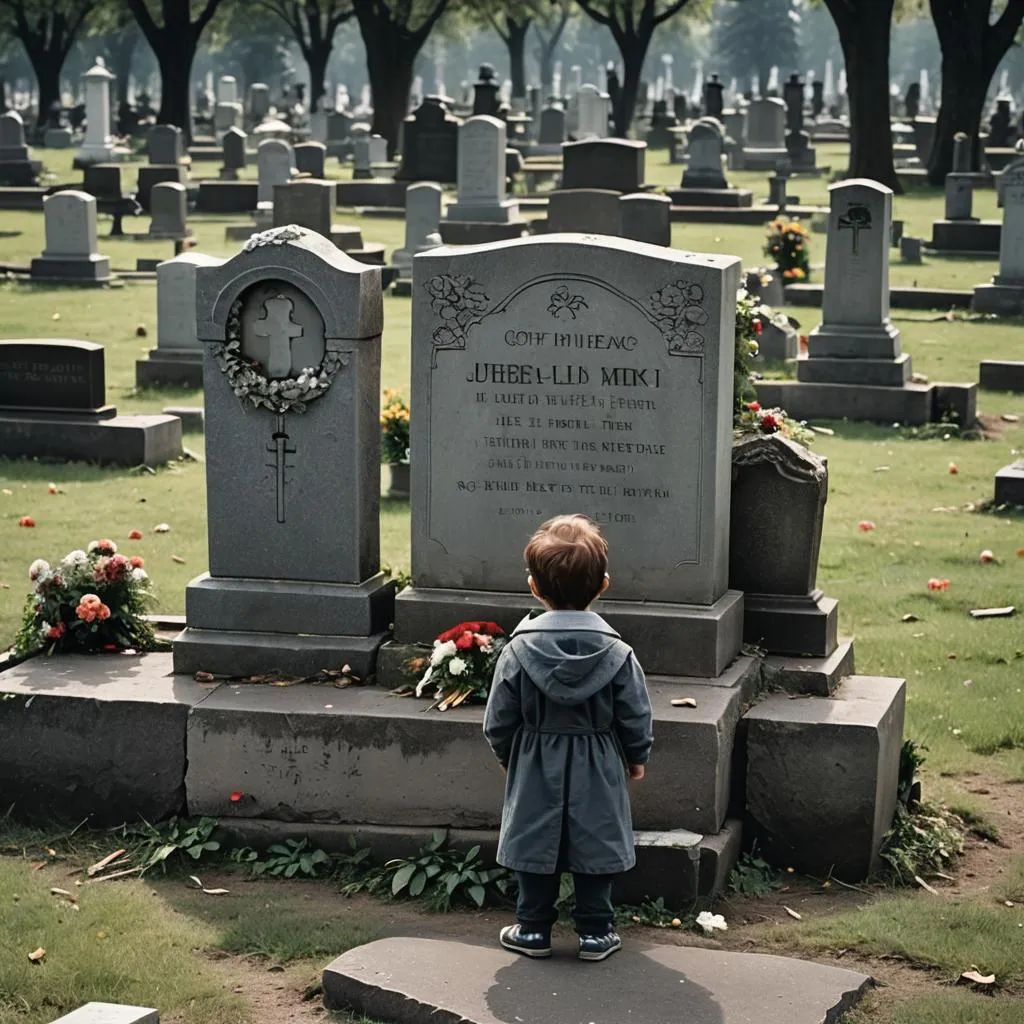
He stood very still the way he always did when he was thinking hard.
That was how his grandmother could always tell — other kids fidgeted, squirmed, moved their bodies around their thinking like water finding a path. Liam went still. Had gone still since he was barely walking, since before he had enough words for the stillness to mean anything anyone could read. His grandmother called it his thinking pose. His kindergarten teacher had called it focused. His father, before, had called it the old soul look and had ruffled his hair when he said it, which Liam could still feel sometimes, the phantom warmth of that hand.
He was five years old and he was standing in front of two graves and he was thinking as hard as he had ever thought about anything.
The flowers somebody had left were starting to brown at the edges. He noticed this in the way he noticed most things — completely, without deciding to. The red ones were holding better than the white ones. There was a beetle moving along the base of the left stone, slow and purposeful, going somewhere with great conviction. The trees overhead made a sound like breathing.
His grandmother stood behind him at a respectful distance, the way she always did when she brought him here — close enough to reach him in two steps, far enough to give him the space that he seemed to need, that she had learned to give him in the eight months since the accident, the eight months of understanding Liam in a way she was still learning the grammar of.
“Mama and Daddy are in there?” Liam said.
It wasn’t really a question. He had asked it before, the first time she’d brought him, and she had answered it carefully and completely because that was what the grief counselor had told her — answer completely, don’t soften too much, don’t create confusions that become harder to undo later. Children, the counselor had said, can hold more truth than we think. What they cannot hold is inconsistency.
“Their bodies are,” his grandmother said. “Yes.”
Liam considered this for a moment. The beetle reached the corner of the stone and turned with great authority and continued along the front edge.
“But not the rest of them,” he said.
“No,” she said. “Not the rest of them.”
This was the conversation they had every time, in slightly different words, circling the same territory the way you walk the perimeter of something large to understand its shape. His grandmother did not find it exhausting. She found it, if she was honest, quietly sacred — this small person in his gray raincoat working out the architecture of the largest question, doing it with the methodical patience of someone who intended to get it right.
“Mrs. Patton says when someone dies they go to heaven,” Liam said.
“A lot of people believe that.”
“Do you?”
His grandmother was quiet for a moment. She was sixty-seven years old and had lived with this question for sixty-seven years and had arrived at something that was less like certainty and more like comfortable uncertainty, which was not the same thing and was also not nothing.
“I believe they’re not gone,” she said. “I’m not always sure exactly where they are. But I don’t think gone.”
Liam turned this over.
“I think Daddy is in the garage,” he said.
His grandmother’s chest did something complicated. “What makes you think that?”
“Because sometimes when I’m in there I can smell his smell.” He said this with perfect seriousness, the tone of someone presenting evidence. “The oil smell. From when he used to fix stuff.” He paused. “And because the light does that thing.”
“What thing?”
“The flickery thing. It didn’t used to do that.” He looked at her over his shoulder for a moment, briefly, then back at the stones. “I think he’s saying hi.”
His grandmother pressed her lips together. She was not going to tell him this wasn’t true because she wasn’t certain it wasn’t true and also because there are some things a child builds to survive and you do not dismantle them just because you cannot verify them.
“I think that might be exactly right,” she said.
Liam nodded, satisfied. He reached into his coat pocket — that small serious hand — and produced a smooth gray stone that he had been carrying for three days, that he had selected from the driveway with great deliberation and carried in his pocket since Tuesday, which his grandmother knew because she had noticed the pocket-checking, the way he verified it was still there every hour or so, the way you check something important.
He placed it carefully at the base of his mother’s stone. Adjusted it once. Then once more.
“So she knows I came,” he said.
His grandmother came forward then, two steps, and stood beside him, and they looked at the graves together — the woman who was sixty-seven and the boy who was five, both of them in coats, both of them doing the same fundamental work of loving someone who was no longer in a reachable place and finding ways to do it anyway.
“She knows,” his grandmother said.
Liam reached up without looking and took her hand. She held it.
The trees breathed. The beetle continued its determined journey. The red flowers held their color in the gray October light.
“Can we get hot chocolate after?” Liam said.
“Absolutely,” his grandmother said.
He looked at the graves one more moment. Then he turned — still holding her hand, pulling slightly forward the way small children pull, forward being their natural direction — and they walked back through the cemetery together, the small boy and the old woman, toward the car and the hot chocolate and the ordinary continuation of a life that had broken open eight months ago and was healing, slowly, in the specific shape of what had been lost.
Behind them, very briefly, the light through the trees shifted. Moved. Settled again.
Liam didn’t see it. He was already talking about hot chocolate, about whether they could get the kind with the little marshmallows, about whether marshmallows floated or sank, his voice carrying back through the stones and the October air, bright and continuous and alive.
His grandmother saw it.
She didn’t say anything. She just held his hand a little tighter, and kept walking, and smiled.
