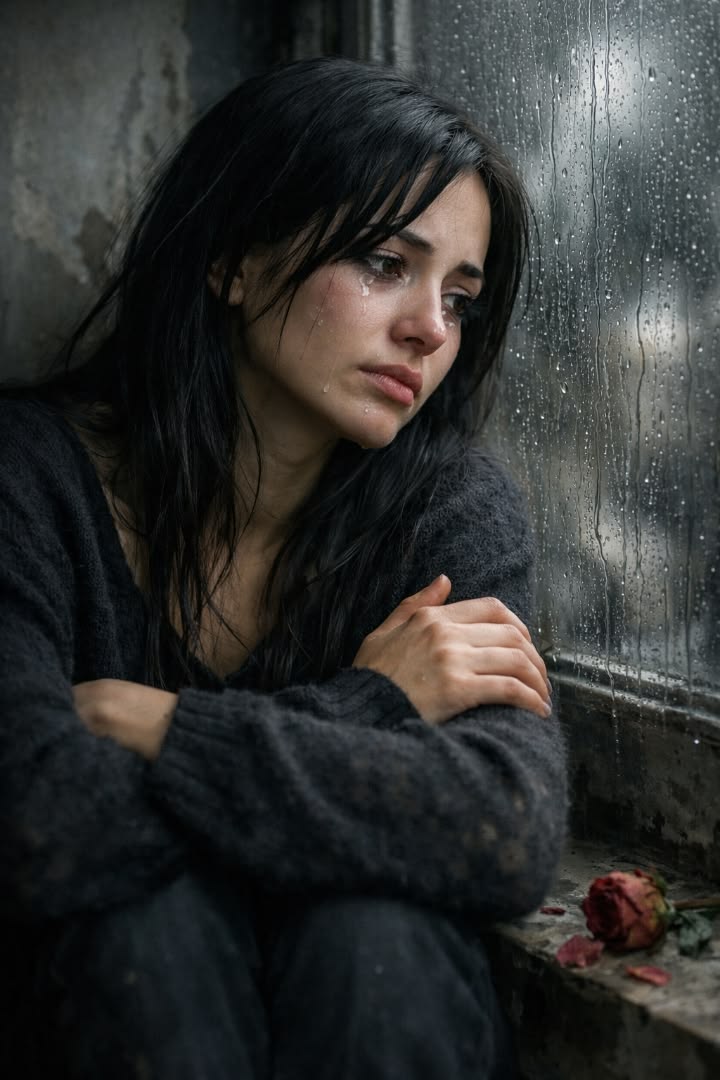
The rain had been falling for three days.
Nora hadn’t counted them deliberately — she’d simply looked up at some point and realized that the window had been wet for what felt like her entire life, that the gray had become the default state of the world outside, that the dead rose on the sill beside her had shed another petal since yesterday and she had watched it fall and had not moved.
She was twenty-nine years old and she was sitting on a window ledge in a black sweater that had once belonged to someone else and was now just hers, the way everything eventually becomes just yours when the person who shared it is gone long enough. The sweater was too big. She had stopped noticing.
The rose was the last one from the bouquet. She knew this was morbid — watching it die on the sill, not throwing it away when the others went, keeping this one as if it were evidence of something. Her therapist, if she were still seeing her therapist, would have something measured and useful to say about that. About the keeping. About what it meant to hold onto dying things past the point of their dying.
She wasn’t seeing her therapist. She had canceled twice and the third time the office had called to check in and she had let it go to voicemail and had not called back, which was its own kind of answer.
The rose had come from Daniel. Seven weeks ago. Delivered to her door on a Tuesday with a note that said, in his handwriting that she had spent three years learning: I know I’m late. I’m sorry. I love you. Please.
She had read the note six times, standing in her doorway in her socks with the bouquet in her hands and the April air coming through the door and the specific feeling of a person who has prepared very carefully for an outcome and is now being asked to consider a different one.
She had put the flowers in water. She had not responded to the note.
They had been together for three years and had ended in the particular way that things end when neither person is a villain — slowly, and with great sadness, and with a final conversation that was more like a mutual acknowledgment than a fight, two people sitting across from each other in a restaurant they’d chosen because it was neutral, neither of their usual places, a place that didn’t belong to their shared history, and saying the true things in the careful voices of people who still loved each other and were choosing something different anyway.
She had chosen the different thing because she had needed to. Had needed to find out what she was without the architecture of them — who she was in a room alone, what she wanted when the wanting was entirely hers, whether the life she’d been building was built toward something she actually desired or just toward the continuation of itself, which was a question she had never been able to answer while inside it.
That had been the theory.
The theory had not accounted for February. For the specific quality of Saturday mornings without him. For the way she would reach a moment in a movie or a song or an ordinary Tuesday and feel the precise shape of his absence, the exact Daniel-sized space in the room that nothing else fit into.
The theory had not accounted for missing him this much, this consistently, this thoroughly even seven months later, in the way that suggested she had perhaps confused figuring out who she was with being alone and these were not the same exercise and she had signed up for one thinking it was the other.
The rose had arrived and she had kept it.
She had not called.
Outside, the rain ran down the glass in slow specific paths — not a sheet of water but individual streams, each finding its own way down, some joining, some diverging, the whole surface of the window a map of small decisions made by physics. She had been watching this for a long time. It was the kind of watching you do when your mind is working on something it won’t show you directly, processing at a level below the surface, and all you can access is the watching.
She was thinking about the note. I know I’m late. I’m sorry. I love you. Please.
She was thinking about what late meant. Whether late was the same as too late, which it often was, but not always — sometimes late was just late, was just the amount of time it took someone to figure out what they knew, was just the gap between understanding and saying, which for some people was weeks and for others was years and for Daniel, who was careful with words in the way of someone who had learned early that words had consequences, had apparently been seven months.
She was thinking about the rose. One petal left.
She was thinking about her therapist’s voicemail, still unreturned.
She was thinking about a specific morning in year two, a Sunday in October, when they had driven to the state park and walked for three hours without a plan and had ended up at an overlook they hadn’t known existed, and she had stood there looking at the valley below and he had stood slightly behind her with his hand on her back and neither of them had said anything for a long time and it had been, she understood now in the retrospective way that moments become clear only once they’re gone, one of the best hours of her life.
A petal fell.
She watched it land on the sill beside the others — soft, slow, already curling at the edges, the red of it going dark.
She looked at the rose. Then at the rain. Then at her phone on the ledge beside her, dark screen, patient.
She picked it up.
She opened his name — still there, unchanged, the small photograph of him from a hiking trip two summers ago still his contact photo because she had never changed it, which was its own kind of answer to questions she had been asking herself for seven months.
She looked at his number for a long time.
Then she began to type.
