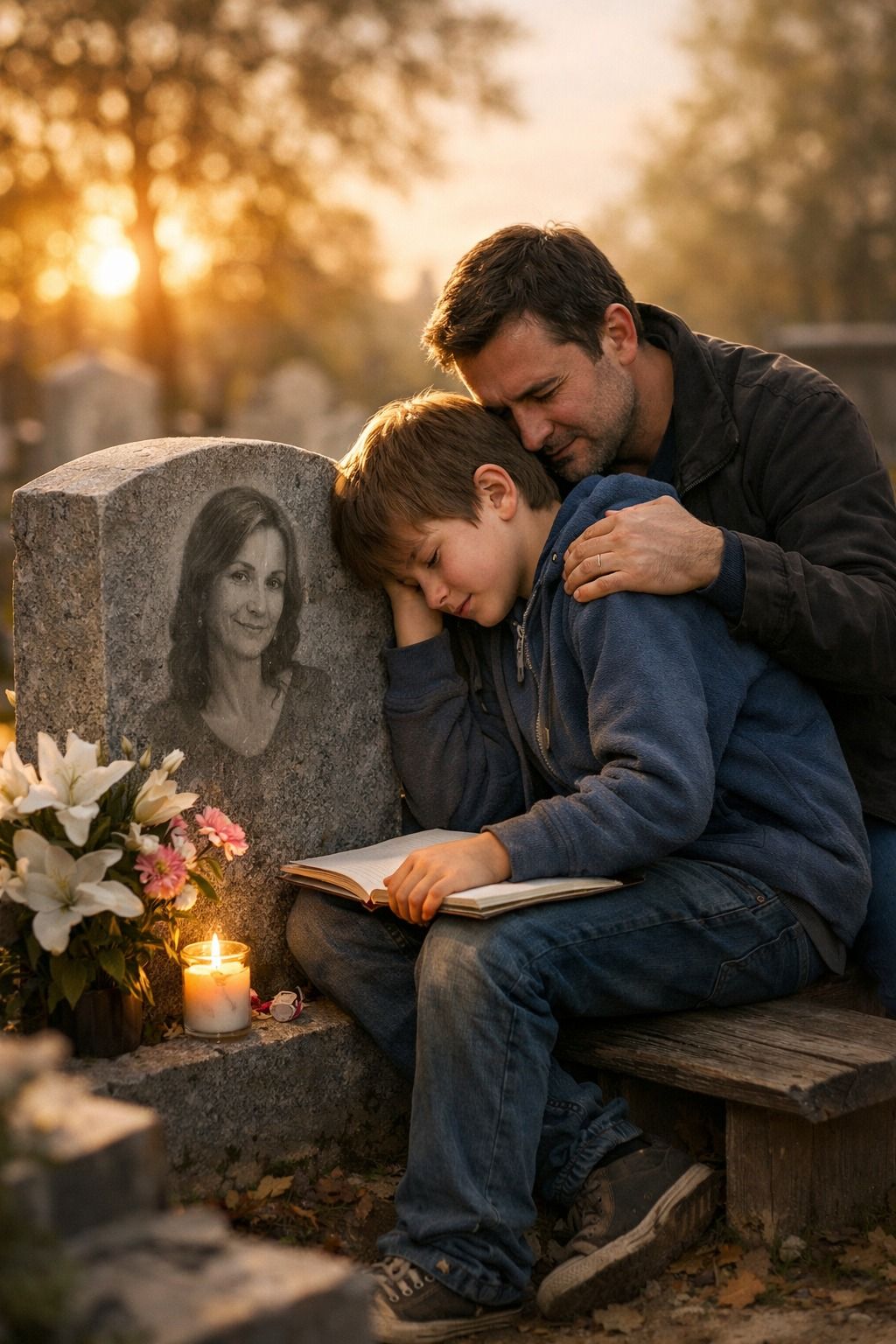
They always came at sunset.
It had started without being decided — the way the most important rituals start, not as choices but as gravitational pulls, the thing you find yourself doing before you’ve named it as a thing you do. The first time had been three days after the funeral, when Ben had driven aimlessly for forty minutes because being in the house was unbearable and being anywhere else felt like betrayal, and had somehow ended up here, in the cemetery parking lot, engine running, staring at the dashboard until Noah had said from the backseat, very quietly: “Can we go see Mom?”
They had gone. They had stayed until the light went golden and then gone gray, and Noah had not cried but had leaned against the stone like it was something warm, which it wasn’t, but which Ben had understood completely.
That was eleven months ago.
Now they came every Sunday. Sunset. Ben brought the candle — the same kind Sarah had kept on the kitchen windowsill, vanilla and something else, a smell that Noah had once said made the whole house smell like Mom, which was the most precise and devastating description of a candle Ben had ever heard. Noah brought the book.
Today the book was open in Noah’s lap, his hand resting on the pages the way you rest a hand on something you’re not quite reading yet, and his head was leaning against Ben’s shoulder, and Ben’s arm was around him, and Ben’s face was tilted down toward his son’s hair in the specific posture of a man trying to give warmth and receive it simultaneously, which was the central physical fact of single parenthood — that you were the only source and also, desperately, in need of the thing you were providing.
The candle flame moved in the evening air. Once, twice. Steadied.
“Dad,” Noah said.
“Yeah.”
“I found something in the book.”
Ben looked down. The book was one of Sarah’s — a novel she’d been reading when she got sick, a bookmark still in it at page 247, which was as far as she’d gotten. Ben had not been able to throw it away. He had not been able to read it either — had picked it up twice and put it back down both times because reading past page 247 felt like going somewhere without her, felt like a small and specific betrayal that he understood was irrational and felt anyway.
Noah had started reading it two weeks ago. He was ten, and it was a book for adults, and Ben had said nothing because Noah reading Sarah’s unfinished book was the kind of grief that deserved to run its course without interference.
“What did you find?” Ben said.
Noah tilted the book. In the margin of page 186, in Sarah’s handwriting — the looping, leftward-leaning script that Ben still sometimes found on grocery lists tucked in jacket pockets, that still stopped his breath — were seven words: Noah will understand this part someday. Save it.
Ben looked at those words for a long time.
“Do you know what it means?” Noah asked.
“Not yet,” Ben said. “What’s happening on that page?”
Noah read him the passage — a paragraph about a father and son on a fishing trip, about the specific silence between people who love each other without needing to fill the air, about how some relationships communicate most clearly in the spaces between words. He read it carefully, with the slight over-precision of a child reading aloud to demonstrate that they understand what they’re reading, and when he finished he looked up at Ben with Sarah’s eyes — she had given him her eyes, dark and attentive, the kind that noticed everything.
“I think I understand it now,” Noah said. “I don’t think I have to wait.”
Ben made a sound that was not quite a word.
“It’s about us,” Noah said simply. “She was writing about us. When she read it.”
The sun was nearly below the tree line, the light going that specific amber that only happened in October, that turned everything it touched into something that looked like memory even while it was happening. The cemetery was quiet around them — they were always the last to leave, Ben and Noah, staying until the light made staying impossible.
Ben tightened his arm around his son.
He looked at Sarah’s photograph on the stone — the one her sister had chosen, from a birthday three years ago, Sarah mid-laugh at something outside the frame, her head slightly back, the expression she had when something genuinely delighted her rather than just the smile she produced for occasions. He had approved the photograph and had been right to — it was her, actually her, the real version — and now he looked at it the way he looked at it every Sunday, with the ongoing conversation that had no words, the one he kept having with a person who was not there and whom he could not stop talking to.
He found your note, he told her. He understood it already. You always said he was older than his age. You were right. You were usually right.
Noah turned another page. Read quietly to himself for a moment, his lips moving slightly. Then stopped.
“Dad. There’s another one.”
Ben leaned in.
Page 203. Sarah’s handwriting again, smaller this time, pressed into the margin in blue ink: Tell Ben — the fishing spot on the Calloway River. He’ll know. Take Noah in the spring. Don’t skip it because it’s hard. Go.
Ben stared at those words.
The Calloway River. He knew it — a place they’d driven past once on a road trip five years ago, before Noah was born, before any of this, when they were just two people with a free weekend and no particular destination. They had pulled over at a bridge and looked down at the water and Sarah had said, “Someday we should fish here,” and he had said, “We don’t fish,” and she had said, “We could learn,” and he had said, “Okay, someday,” and someday had never come and he had not thought about it in five years.
She had remembered. Had held it. Had written it down in a book she was reading while she was dying, in a margin, in blue ink, as if she had known someone would need it.
The candle flame held steady in the still air.
“What does it say?” Noah asked.
Ben closed his eyes for one second. Then opened them.
“It says we’re going fishing in the spring,” he said.
Noah looked at him. Then at the photograph on the stone. Then back at Ben, with those dark attentive eyes.
“Mom never fished,” he said.
“I know,” Ben said. “She thought we should learn.”
Noah considered this for a moment, in the serious way he considered most things. Then something shifted in his face — not quite a smile, something gentler than that, something that was closer to recognition, to the specific comfort of a person who has just heard something that sounds unmistakably like the person they lost.
“Okay,” he said. “Spring.”
The last light left the trees. They sat a while longer in the dark and the candle, father and son, the book between them full of her handwriting, the stone warm-looking in the flame even though it wasn’t.
Then Ben lit his phone flashlight and they walked back to the car, Noah carrying the book against his chest with both arms the way you carry something that matters.
In the spring, they would go to the Calloway River. They would rent rods from a shop in town and learn from a YouTube tutorial and do everything wrong for the first two hours and then Noah would catch something small that they would release back into the water, and neither of them would say anything, and the silence would be full of her in the way of the passage on page 186, and Noah would look at his father across the water with Sarah’s eyes and Ben would understand, completely, what she had been saving that page for.
But that was spring. Tonight was now — the candle and the stone and the book and the two of them, moving through the dark toward the car, together.
