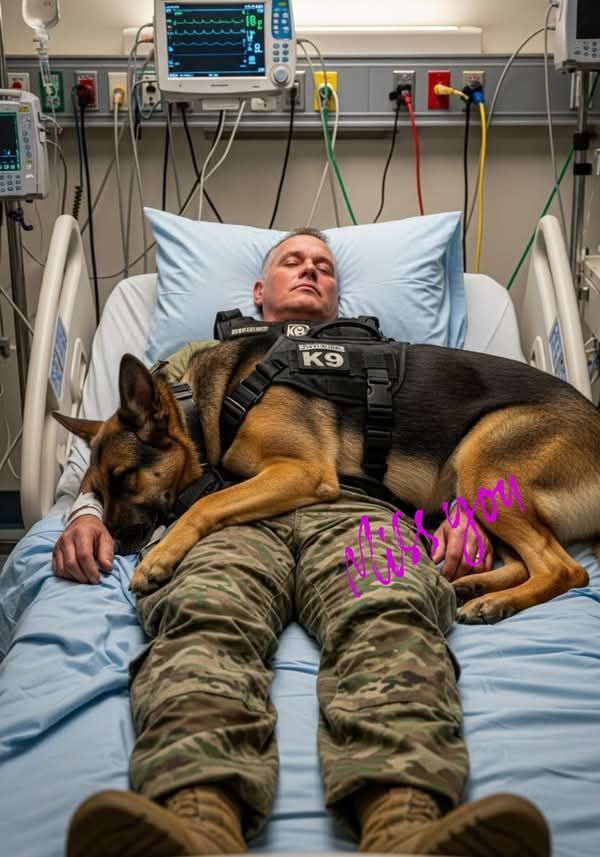
The monitor beeped.
It had been beeping for six days — the same steady, mechanical pulse, indifferent to hour or weather or the particular quality of grief that had settled into Room 14 of the ICU at Brooke Army Medical Center like a fifth presence alongside the patient, the dog, the machines, and whatever it is that waits in hospital rooms when the outcome is not yet decided.
Sergeant First Class Dale Morrow, forty-four years old, lay in the bed with his eyes closed and his hands still and his chest rising and falling with the assisted rhythm of a man whose body was doing the work of surviving while the rest of him was somewhere else — somewhere the monitors couldn’t track and the doctors couldn’t map and the people who loved him could only hope was not too far away to come back from.
Duke was curled across his legs.
He had been there for most of the six days.
The hospital had rules about animals. Every hospital has rules about animals, and Brooke Army Medical Center was no exception, and the rules were clear and reasonable and had been explained twice to Corporal Angela Reyes, Dale’s partner of four years and the person who had driven two hundred miles from Fort Cavazos with Duke in the back seat of her personal vehicle because she had decided, with the calm certainty that sometimes replaces panic when panic has run its course, that the rules were going to have to make an accommodation.
The charge nurse, a twenty-year veteran named Barbara who had seen most of what a military hospital could show a person, had looked at Angela. Had looked at Duke — seventy-two pounds of German Shepherd in full K9 tactical vest, sitting at perfect attention in the ICU corridor with the focused stillness of a working dog who understood that this was not a drill. Had looked back at Angela.
Had said: “I didn’t see anything. Visiting hours end at eight.”
Duke had not left at eight.
Nobody had asked him to.
Dale Morrow and Duke had been partners for four years, which in K9 terms is a long time and in human terms is approximately the length of a graduate degree — enough time to know someone in the specific, wordless way that shared work and shared danger produce, a knowledge that lives below language in the part of the mind that tracks things like breathing patterns and muscle tension and the thousand small signals that mean something is wrong before the conscious mind has assembled the evidence.
They had deployed together twice. They had made eleven confirmed drug interdictions, three explosive finds, one hostage situation that Dale did not discuss and Duke did not forget. They had driven three hundred thousand miles in a government-issue vehicle with a K9 partition between them and a working understanding that the partition was a bureaucratic formality, because Duke’s head was usually through it and resting on the center console and Dale’s hand was usually on it, and that was simply the operational reality.
When people asked Dale what it was like to work with a dog, he said it was like working with the best partner he’d ever had, and when they followed up by asking if that was sad — to compare a dog favorably to a human being — he said he didn’t find it sad at all, and that perhaps the comparison said more about the state of human partnership than it did about dogs.
He had been making that joke for four years.
He wasn’t making jokes now.
The incident had been a traffic stop that became something else.
That was how most of the bad ones went — not the operations you spent weeks planning, not the high-profile situations with full backup and tactical preparation, but the ordinary Tuesday afternoon moments that reclassify themselves without warning. A stop for expired plates. A driver who made a decision. A firearm that materialized from somewhere in the vehicle before Dale had fully processed the threat, because threat processing takes a quarter second and human beings don’t always have a quarter second.
Duke had gone through the window before the first shot landed.
The official report — which Angela had read four times in the waiting room of the ICU, because reading it was the only way she knew to be useful — described what happened next in the flat, passive language of incident documentation, which is a language designed specifically to contain things that ordinary language cannot hold without breaking. Duke had engaged the suspect. The suspect had discharged a second round before the engagement concluded. Dale had been struck once, center mass, with damage to his right lung and three ribs and a trajectory that the trauma surgeon described, to Dale’s wife Karen who had flown in from Fayetteville, as millimeters from a different conversation.
Millimeters.
Duke had a laceration across his left shoulder that required sixteen stitches. He wore a light bandage over it now, partially visible beneath his tactical vest, which Angela had not removed because it seemed important — seemed like a signal, to Dale or to whatever was hovering in Room 14 making its decision — that Duke was still on duty. Still working. Still present in the official, committed sense of the word.
The monitor beeped.
Duke lifted his head, the way he had been lifting it every forty minutes or so for six days — checking, assessing, confirming — and then laid it back down across Dale’s legs with the precision of an animal that has selected its position deliberately and intends to hold it.
Karen sat in the chair beside the bed and watched the dog and thought about the word millimeters and what it contained.
Angela stood in the doorway on her fourth cup of vending machine coffee and watched the monitor and the dog and her partner’s still face.
Outside the window, San Antonio was going about its business — traffic and ordinary Tuesday and people who would go home tonight to their dinners and their families without having spent any portion of their day in a room where a monitor beep was the most important sound in the world.
Inside Room 14, Dale Morrow breathed.
In. Out. In. Out.
The assisted rhythm of a man holding on.
Duke’s ear twitched. His nose moved — that slow, deliberate scent-assessment that Angela had watched thousands of times in the field, the physical gesture of a dog processing information, sorting signal from noise, drawing conclusions that his brain arrived at faster and more certainly than any human instrument.
He lifted his head again.
This time he didn’t put it back down.
He looked at Dale’s face — directly, intently, with the locked focus that Angela knew meant alert, something has changed — and made a sound that was not a bark and not a whine but something between them, something that had no name in English but that Barbara the charge nurse, passing in the hallway, heard through the open door and stopped walking.
Dale’s hand moved.
Not much. Not dramatically. Not the kind of movement that makes people in movies gasp and reach for each other. Just his right hand, which had been open and still on the blanket for six days, closing slowly around a handful of the fabric of Duke’s vest.
The grip of a man who knows what he’s holding onto.
The grip of a man who is, unmistakably, still here.
