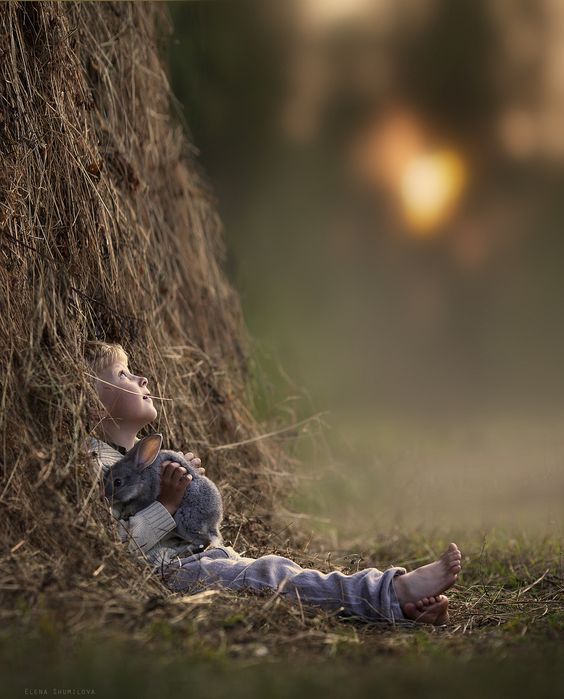
Nobody in Millfield, Indiana ever thought much about the old Hargrove farm at the edge of town. It sat at the bottom of a long gravel road, surrounded by fields that smelled like warm earth and cut grass, and most folks drove past it without a second glance. But if you had stopped your truck on a late August evening — right around the hour when the sun melts into something golden and soft — you might have seen a small boy sitting against the haystack at the far edge of the field. And if you had looked closer, you would have noticed he was never alone.
His name was Caleb. Seven years old, barefoot from April through October, with the kind of quiet that made adults nervous and animals comfortable. He had a gap between his two front teeth and a habit of chewing on straw that drove his mother absolutely crazy. She said it looked like something out of an old movie. He said it helped him think. Neither of them was wrong.
The rabbit had shown up in early June. Small and gray, with ears that seemed too big for its body and dark eyes that caught light the way still water does. Caleb had found it trembling behind the chicken coop, thin and shaking, and he had done what any boy raised on that farm would do. He sat down in the grass beside it and waited. He didn’t reach for it. He didn’t make a sound. He just let the creature understand, in the way animals understand things, that he meant no harm.
It took forty minutes. His mother watched from the kitchen window, drying the same dish over and over without realizing it.
By the time supper was ready, the rabbit was in his lap.
He named it Chester, and from that evening forward, the two of them were inseparable. Caleb carried Chester through the fields every morning before the dew had burned off. He held him while he watched the clouds. He talked to him the way some kids talk to imaginary friends — low and steady, like sharing secrets with someone he trusted completely.
His father, Roy, tried to explain to him that rabbits don’t understand words. Caleb had nodded politely and said nothing, which was his way of disagreeing without causing trouble.
Because Caleb knew something his father didn’t.
He didn’t talk to Chester to be understood. He talked to sort himself out. When he was afraid, the words came out and the fear shrank. When he was angry, he could say the angry thing to Chester’s soft gray ears and watch it dissolve into the warm summer air. Chester never judged. Chester never told him he was wrong or too sensitive or too young to understand. Chester just sat there, breathing slowly, and that breathing steadied Caleb like a hand on the shoulder.
The evening the photograph happened — though Caleb didn’t know anyone was taking his picture — was the evening everything in his life changed.
It had been a hard day. His grandfather, a man named Walter who smelled like pipe tobacco and old leather, had gone to the hospital two weeks before and hadn’t come home. Nobody sat Caleb down and explained it plainly. They used words like resting and at peace and gone to a better place, and Caleb hated every single one of them. He didn’t want his grandfather in a better place. He wanted him in his usual chair, watching the evening news too loud, sneaking Caleb an extra cookie when his mother wasn’t looking.
He had taken Chester from the hutch without saying where he was going and walked to the big haystack at the field’s edge. He leaned his back against it, felt the dry scratch of it through his shirt, and looked up. The sky was doing something extraordinary. The last of the sun was catching in the mist that drifted up from the low ground, turning the whole world amber and gold, and the light hung in the air like something that didn’t want to leave.
He thought about his grandfather.
He thought about how the man had taught him to skip stones on Miller’s Creek. How he’d called Caleb partner every single morning like it was the most natural thing. How his hands had been enormous and rough and absolutely safe.
“I don’t know where he went,” Caleb told Chester quietly. “But I think the sky knows.”
Chester shifted in his arms and pressed closer.
“I think maybe,” Caleb continued, his voice barely above a whisper, “when people go, they kind of turn into light. And that’s why evenings look like this. Because everybody who left is just saying — I’m still here. You don’t have to worry.”
He wasn’t sure he believed it. But he wasn’t sure he didn’t.
He chewed his piece of straw and watched the golden light pulse through the mist, and for the first time in two weeks, the weight in his chest loosened — just slightly, just enough.
He didn’t know that his mother, who had come looking for him, had stopped at the edge of the field when she saw him there. He didn’t know she had her phone raised. He didn’t know she was crying quietly, not from sadness exactly, but from something closer to awe — the particular awe of watching your child be more wise than you raised him to be.
The photograph would sit in a frame on her bedside table for the rest of her life. Caleb leaning against the hay, bare feet stretched out in the grass, chin tilted toward the sky. Chester bundled against his chest, small and gray and still. The golden light behind them, impossibly gentle.
She would tell people it was her favorite picture she ever took.
And Caleb, when he got older and someone asked him about it, would simply say: “That was the evening I figured it out.”
Nobody ever asked him what exactly he had figured out.
Maybe they were afraid the answer would be too simple. Or maybe — and this is more likely — they were afraid it would be exactly true.
