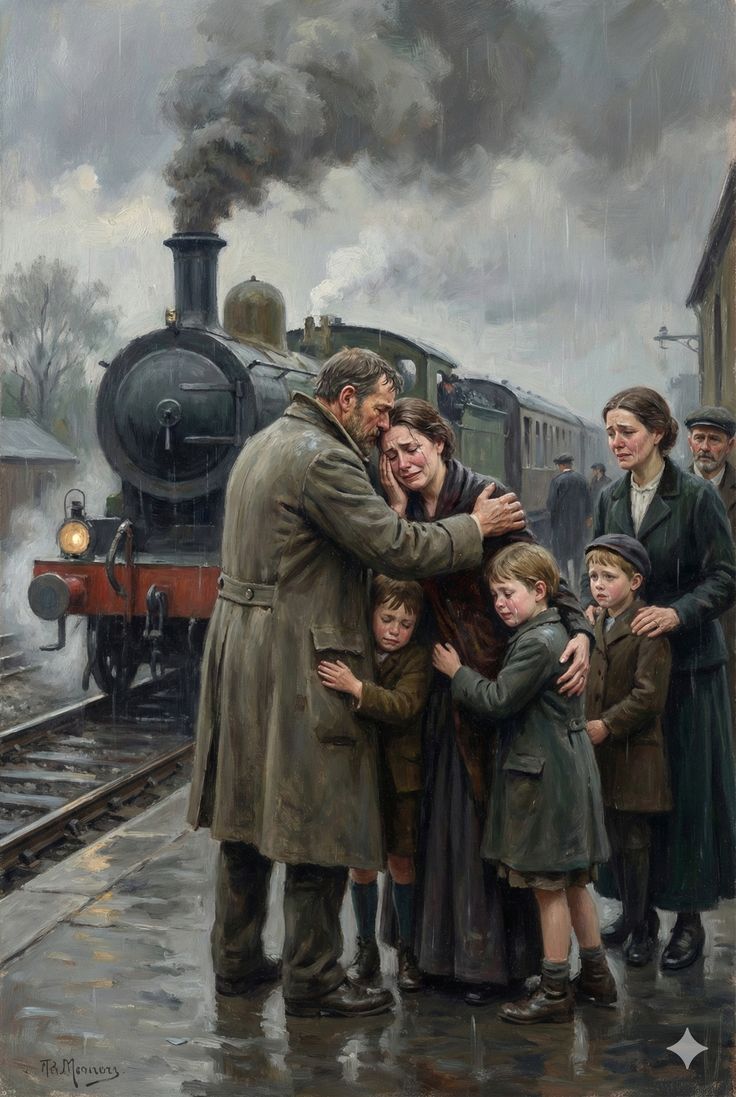
The rain had been falling since before dawn, and it showed no intention of stopping.
Margaret Callahan stood on Platform 3 of the Harrisburg train station with her three boys pressed against her sides and her husband’s hands cupped around her face, and she understood — in the way you understand something that your mind refuses to fully accept — that this was the last morning she would feel those hands for a very long time. Maybe longer.
His name was Thomas. Forty-one years old, broad-shouldered, with deep-set eyes the color of creek water and a jaw that had never quite learned to soften. He was not a man who cried easily. He had grown up in a Pennsylvania coal town where men measured their worth in silence and endurance, where feelings were private things kept locked somewhere below the sternum. But standing on that platform in the November rain of 1942, with his wife’s tears warm against his palms and his boys clinging to the fabric of his coat, Thomas Callahan’s jaw was trembling.
He was losing the fight.
“Look at me,” he said quietly. “Margaret. Look at me.”
She lifted her eyes to his. They were red and swollen, but steady. That was Margaret — steady in the way of people who have survived things before and know they will survive this too, even when every part of them is screaming that they won’t.
“I’m coming home,” he said. Not I’ll try or God willing or any of the soft, careful phrases people used when they weren’t sure. He said it the way he said everything that mattered — flat and certain, like a nail driven flush.
She nodded. She couldn’t speak.
Behind them, the locomotive exhaled a long slow breath of steam that drifted across the platform and swallowed the legs of the other families standing in their own private griefs. There were dozens of them. Men in Army-issue coats with duffel bags at their feet. Women holding themselves together with both arms. Children who were too young to understand and old enough to feel every inch of what they didn’t understand. The whole platform was its own kind of church — hushed and heavy and full of prayers nobody was saying out loud.
Thomas crouched down to his boys.
Patrick was twelve and doing his level best to look like he wasn’t falling apart. He had his father’s jaw, and he was working it hard. Thomas gripped the back of his neck the way fathers do when words aren’t enough.
“You’re the man of the house,” Thomas said. “You know what that means?”
Patrick nodded.
“It means you look after your mother and your brothers. It means you don’t complain about the hard things. It means you show up.” He paused. “Can you do that?”
“Yes, sir,” Patrick said, and his voice only broke on the last word.
Then there was Danny, who was nine and had his mother’s eyes and her terrible habit of feeling everything twice as much as was comfortable. He had stopped trying to hold back and was simply crying — openly, without shame — his small face pressed into his father’s shoulder.
Thomas held him for a long moment without saying anything. Sometimes there’s nothing to say. Sometimes the holding is the thing.
And then there was little Frankie. Six years old, gap-toothed, with no real understanding of where his father was going except that it was far and that everyone around him was sad and that his coat was wet from the rain. He tugged at Thomas’s sleeve and said, with complete seriousness: “Daddy, will you bring me something back?”
Thomas laughed — actually laughed — and the sound of it cut through the gray morning like something warm and unexpected. He picked Frankie up and held him against his chest.
“What do you want?” Thomas asked.
Frankie thought about it with the gravity of a boy weighing a very important decision. “A rock,” he said finally. “From wherever you go. So I know you were really there.”
Thomas pressed his lips to the boy’s forehead and closed his eyes for a moment longer than necessary.
“Deal,” he said. “One rock.”
He set Frankie down. He stood. He looked at Margaret one more time, and in that look was everything — twenty years of marriage, three boys, a house on Elm Street with a porch that needed painting, Sunday dinners and arguments about money and the way she laughed when she thought something was genuinely funny and the side of the bed that was his and the coffee cup she always left out for him and the particular weight of her hand in his when they walked anywhere together. All of it. All of it passed between them in that one look without a single word.
He kissed her once — hard and certain, the same way he said important things.
Then he picked up his duffel bag and walked toward the train without looking back. Because he knew if he looked back, he wouldn’t be able to keep walking. And the train was not going to wait.
Margaret watched him go. Her boys gathered around her automatically, the way children do — finding the center of warmth and holding to it. She put her arms around all three of them and stood there on the wet platform as the train doors closed and the locomotive groaned and the great wheels began to turn.
She watched until the train was gone. Until the smoke thinned. Until the platform began to empty around her and the rain kept falling on the wet rails that led somewhere she couldn’t follow.
Then she straightened her coat, looked down at her three boys, and said: “Alright. Let’s go home.”
Because that is what women like Margaret Callahan did. They turned back toward the life that remained and they kept it standing. They kept the lights on. They kept the table set.
They kept the faith.
