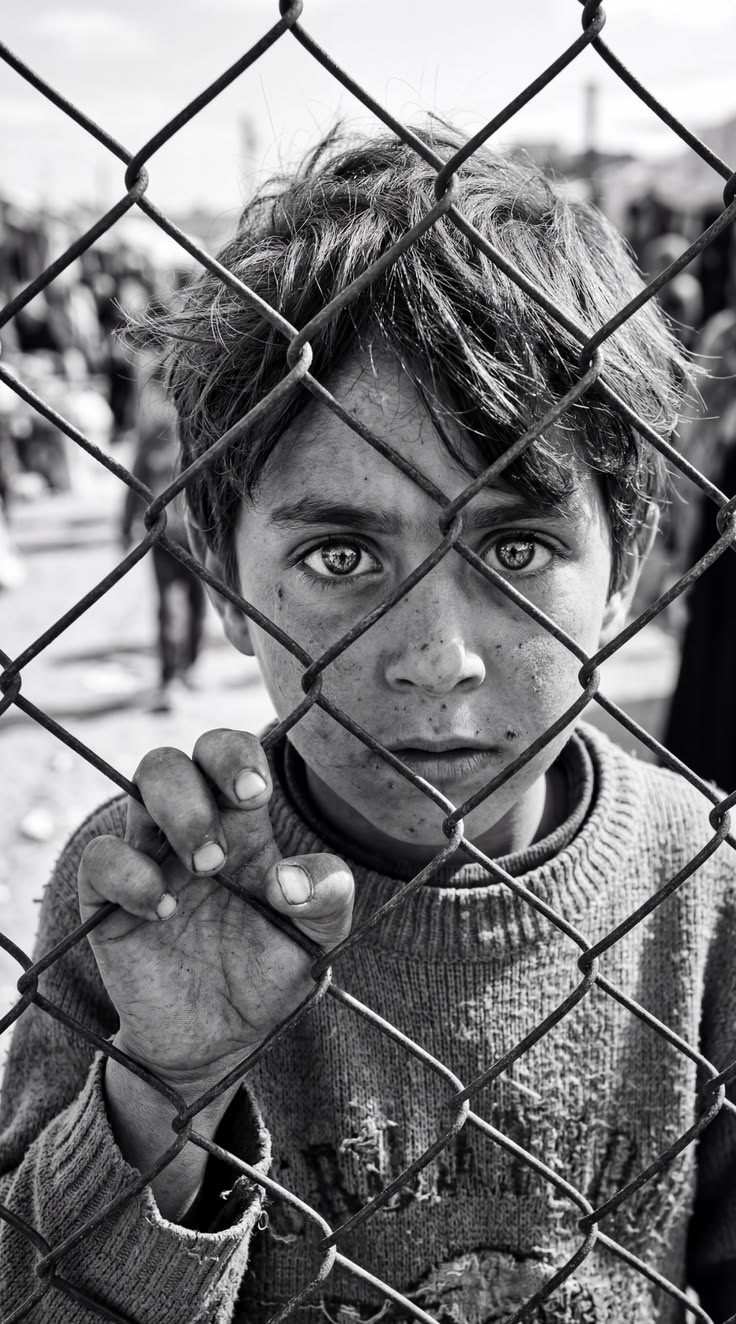
His name was Tariq, and he was nine years old the last time he slept in a real bed.
That was fourteen months ago, in a small apartment in Aleppo where his mother kept a pot of jasmine on the windowsill and his father came home every evening smelling of sawdust and engine oil. Tariq had a younger sister named Lina, who was six and obsessed with drawing horses on every scrap of paper she could find. He had a grandmother who made the best kibbeh in the neighborhood, and neighbors who argued too loud through thin walls, and a school where his teacher, Mr. Hasan, once told him he had the sharpest mind in the class.
He had a life.
Then one Tuesday morning, the sky fell.
Not metaphorically. Not in the way poets mean when they say the world collapsed. The sky actually fell — in concrete and fire and a sound so enormous it had no name. Tariq was walking to school when the first strike hit four blocks away. He remembers the ground shaking beneath his sneakers. He remembers running. He doesn’t remember which direction. He just ran the way animals run from fire — without thought, without plan, without anything but the ancient instruction written in every living cell: survive.
He found his mother two hours later at a neighbor’s house. His sister was with her, clutching a drawing of a horse she had somehow carried through the chaos. His father arrived at nightfall, cuts on his hands, saying nothing for a long time. His grandmother never arrived at all.
They waited three days in case she came.
She didn’t.
What followed was a journey that Tariq can only describe in fragments, the way you describe a nightmare the morning after — pieces that don’t connect cleanly, images that make no logical sense when laid end to end. A truck. A long road through the dark. Strangers pressed together so tightly he could feel their heartbeats. A border crossing where a man with a flashlight shone it into his mother’s face for a long, silent moment before waving them through. A camp. Another camp. A registration line that lasted eleven hours. A tent.
The tent became home.
Americans might struggle to understand what a tent means when it’s home. In the United States, a tent means a camping trip. It means s’mores and ghost stories and a sleeping bag that smells faintly of last summer. It means you go home on Sunday. For Tariq, a tent meant a floor that became mud when it rained. It meant no electricity except for the hours the generator ran. It meant his sister Lina stopped drawing horses because there was no more paper, and no one thought to bring any, and somehow that small loss felt enormous in a way that bigger losses didn’t — because bigger losses were too big to feel all at once.
The fence came later.
The camp was fenced for security, the administrators said. To keep order. To know who was inside and who was outside. Tariq understood this, in the way that children understand rules that apply to them without having agreed to them. He did not resent the fence exactly. He simply noticed it the way you notice a ceiling — constantly, without thinking about it, until the day you realize you haven’t seen open sky without an obstacle between you and it in a very long time.
He spent hours at the fence. Not because he planned to. But because the fence was the edge of the world he was permitted to inhabit, and there is something in human beings — something deep and unarguable — that is drawn to edges. To the place where here ends and there begins.
On the other side of the fence, trucks came and went. Aid workers in vests carried clipboards. Journalists came occasionally with cameras, took photographs, and left. Tariq watched them leave with the particular attention of someone who has learned that some people get to leave and some people don’t, and he is still learning which kind of person he is.
One afternoon, a journalist crouched down to his eye level and asked, through an interpreter, what he wanted to be when he grew up.
Tariq thought about Mr. Hasan, who said he had the sharpest mind in the class.
“A doctor,” he said. “So I can help people who are hurt.”
The journalist nodded, took the photograph, and left.
Tariq stood at the fence for a while after, his fingers curled through the chain-link, looking out at the road that led away from the camp, toward somewhere he had no name for. His eyes — those extraordinary, ancient-looking eyes that seemed to carry more than nine years of living — did not fill with tears. He had learned something that no child should ever have to learn: that tears are a resource, like water, like food, like hope, and they must be rationed carefully.
His sister came and stood beside him. She had found a stick. In the dirt, she was drawing a horse.
That image — the girl drawing horses in the dust while her brother holds a fence and stares at a horizon he cannot reach — is the image that should stop every American in their comfortable certainty that the suffering of distant children is a political issue and not a human one. It is not a political issue. It is a nine-year-old boy with sharp eyes and a doctor’s dream, standing at the edge of the only world he is allowed.
His name is Tariq.
He still doesn’t know which kind of person he is — the kind who gets to leave, or the kind who stays.
He is still waiting to find out.
